Best Home EV Chargers for Electric Car Owners Charging Overnight
Affiliate Disclosure: As an Amazon Associate, we earn from qualifying purchases made through links on this page, at no extra cost to you. This helps support our work and keeps our guides free to read.
A quick note on prices: prices change often, so we never quote a fixed price here. Please check the latest price on Amazon before you buy, using the yellow buttons in this guide. The product pictures in this article are original illustrations created for this guide, not manufacturer photos.
There is a particular pleasure in coming home, plugging the car in, and forgetting about it until morning. If you are comparing the best home ev chargers for electric car owners charging overnight, you are really looking for one thing: a charger that quietly and safely does its work while you sleep, so every day starts with a full battery and no detour to a public charger. Done well, overnight ev charging at home is the cheapest and easiest way to run an electric car.
The heart of almost every setup is a level 2 home charger, which charges several times faster than the basic cable that came with the car, easily refilling a typical battery between dinner and breakfast. Many owners also want a smart ev charger with scheduling, so charging waits until off-peak hours when electricity costs less. This guide covers both, from simple plug-in units to app-controlled wall boxes that juggle two cars at once.
Two decisions matter more than any badge on the box. The first is ev charger installation at home: every fixed charger needs a suitable circuit, and that work belongs to a qualified electrician who knows your local electrical codes. The second is the plug in vs hardwired ev charger question — plug-in units move with you, while hardwired units are neater and often faster. We flag which is which for every pick below.
How We Chose
We compared chargers on the things that decide whether overnight charging feels effortless or annoying: charging speed in the 7kW to 11kW class, cable length and how the cable stores, scheduling and app quality, and build quality for garages and outdoor walls. Every pick here is a generic type from established charging categories, and we favoured designs with clear safety certifications and straightforward controls over novelty features.
Safety shaped the shortlist throughout. A home charger draws serious power for hours at a time, so we only included types with proper thermal protection, weather sealing where they are meant for outdoors, and installation instructions written for professionals. Whatever you choose, have a qualified electrician assess your consumer unit and fit the charger, and follow your local electrical codes — that advice applies to every product in this guide.
Quick List
- Smart Wall Charger with App Scheduling — the all-rounder for off-peak overnight charging.
- Plug-In Wall Charger with Long Cable — easy to fit, easy to take with you.
- Weatherproof Outdoor Wall Charger — built for driveways without a garage.
- Portable Level 2 Charger with Travel Case — home speed that packs into the boot.
- Dual Connector Wall Charger for Two Cars — one unit, two electric cars.
- Slim Compact Garage Wall Charger — for tight garages and narrow walls.
- Solar Ready Smart Wall Charger — charges from your own sunshine.
- Heavy Duty Wall Charger with Extra Long Cable — reaches awkward parking spots.
- Wall Charger with RFID Access Control — keeps shared driveways secure.
- Simple Wall Charger with Built-In Delay Timer — no app, no fuss, still off-peak.
- Adjustable Amp Wall Charger for Older Panels — gentle on older home electrics.
- Wall Charger with Dynamic Load Balancing — shares power with the house safely.
1. Smart Wall Charger with App Scheduling

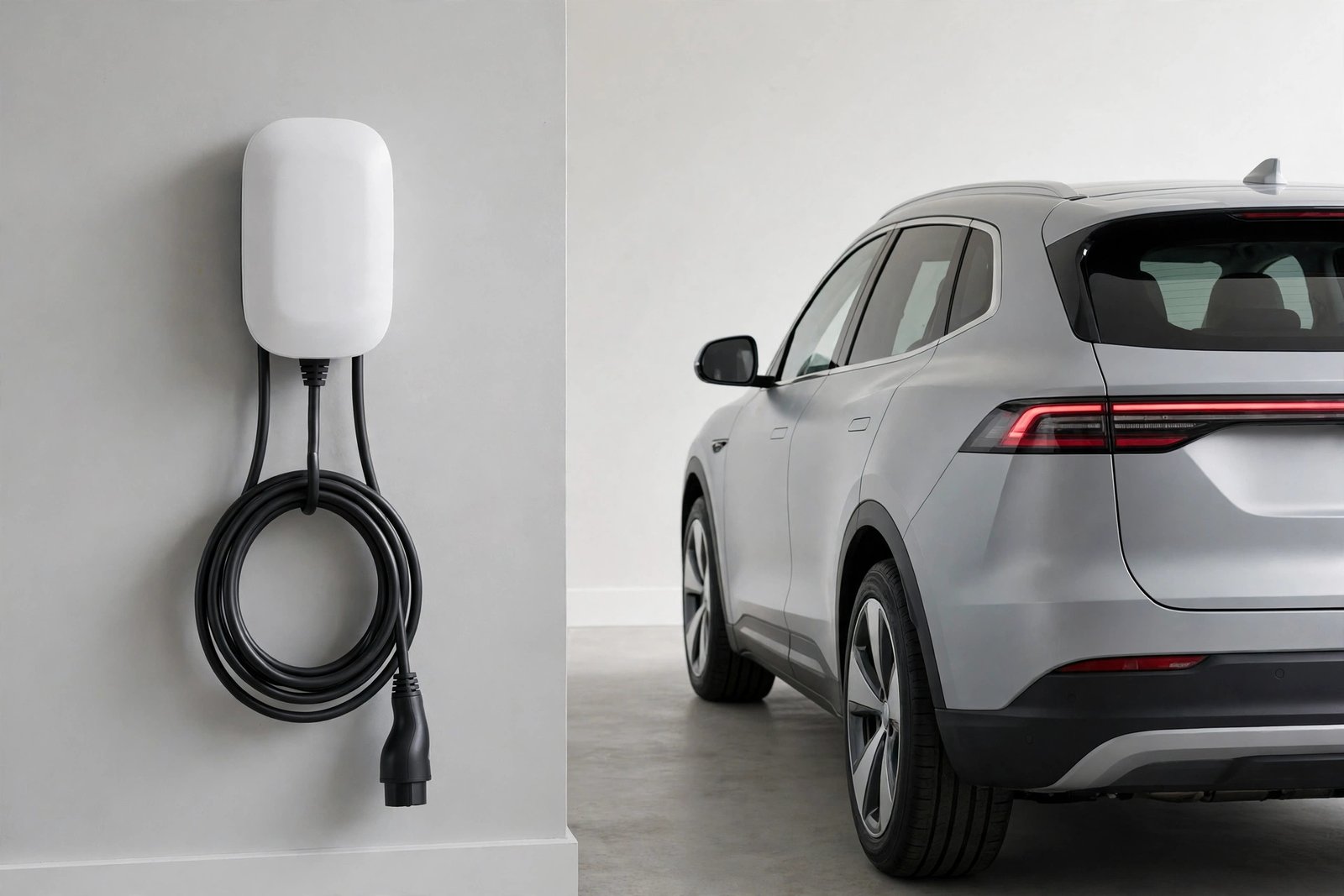
For most people, the Smart Wall Charger with App Scheduling is the pick that makes overnight ev charging at home feel completely automatic. You set your off-peak window once in the app, and the charger waits patiently until electricity is cheapest before it starts work, then sends a quiet notification when the car is full. At up to 11kW it comfortably refills even a large battery overnight, and the usage reports show exactly what each charge cost, which is oddly satisfying at the end of the month.
Wall mounting keeps the cable tidy on its own holster, and the better versions of this smart ev charger with scheduling can also pause charging if the household load spikes. You will need a suitable circuit fitted by a qualified electrician, and a reasonable Wi-Fi signal where the car parks. If your tariff rewards off-peak use, this is the charger that quietly earns its keep.
Pros
- Automatic off-peak scheduling saves money nightly
- Up to 11kW refills large batteries overnight
- App reports show energy used per charge
- Tidy wall-mounted cable storage included
Cons
- Needs Wi-Fi coverage where the car parks
- Hardwired fitting means electrician costs apply
- App features vary between versions
Best for: owners on off-peak tariffs who want set-and-forget overnight charging.
Check Price And User Reviews on Amazon
2. Plug-In Wall Charger with Long Cable

The Plug-In Wall Charger with Long Cable is the friendly middle ground in the plug in vs hardwired ev charger debate. It mounts on the wall like a fixed unit, but connects through a heavy-duty socket, so an electrician can fit the socket once and you can unplug the charger and take it with you if you move house. The generous cable, usually around seven metres, reaches cars parked nose-in or reversed without a nightly parking performance.
Charging speeds on this type of level 2 home charger typically sit in the 7kW to 9kW range depending on the socket and circuit, which is still plenty for overnight ev charging at home. Check that the plug type matches the socket your electrician fits, and never be tempted by adaptors or extension leads — a charger should always connect directly. Renters with a landlord’s permission often find this the easiest route to proper home charging.
Pros
- Removable, so it can move house with you
- Long cable suits flexible parking positions
- Simpler fitting than hardwired models
- Full overnight charging speed for most cars
Cons
- Still needs a dedicated socket and circuit
- Slightly slower than the fastest hardwired units
- Plug connection should be checked periodically
Best for: renters and movers who want proper wall charging without a permanent fitting.
Check Price And User Reviews on Amazon
3. Weatherproof Outdoor Wall Charger
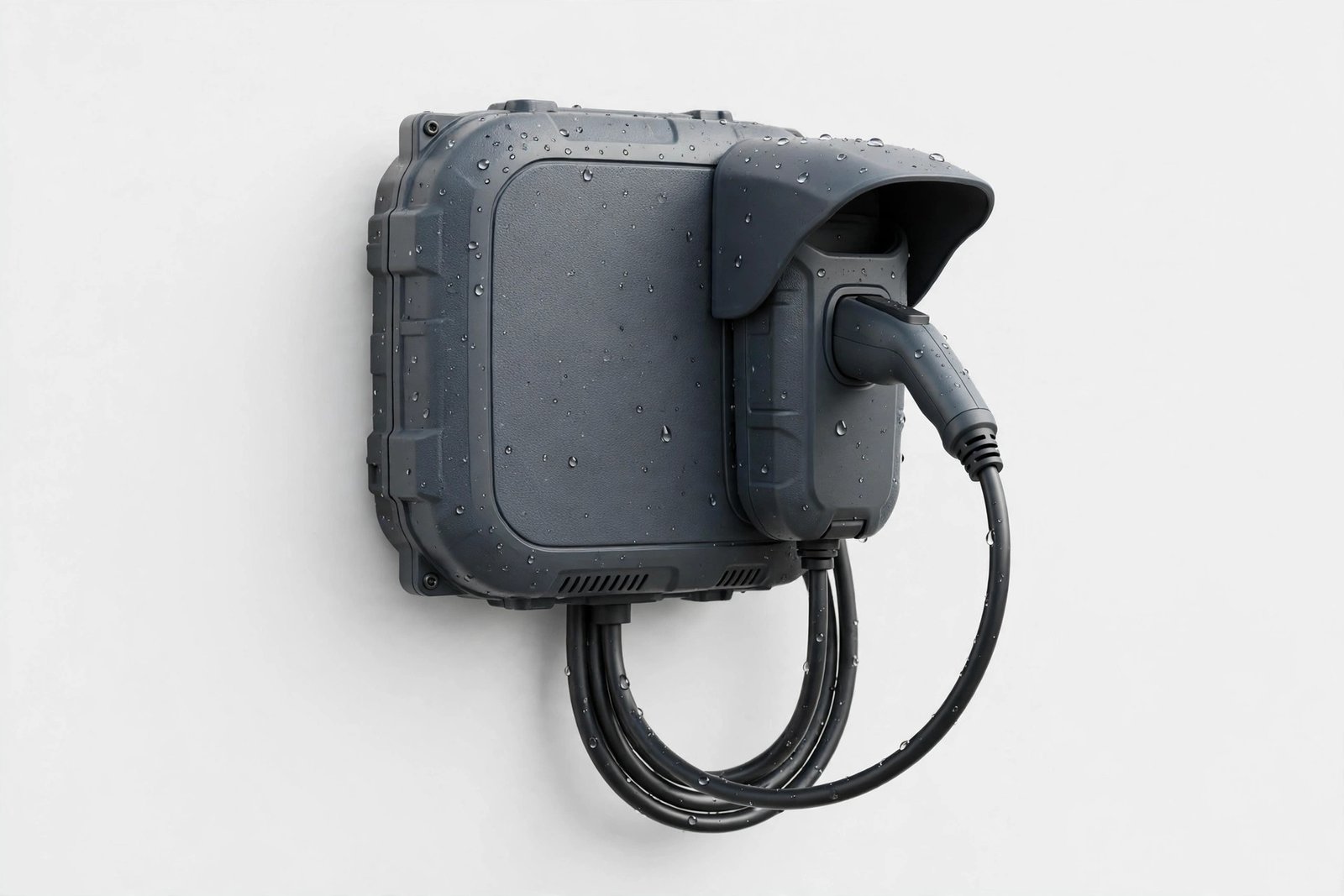
No garage, no problem: the Weatherproof Outdoor Wall Charger is sealed against rain, dust and frost, and is designed to live on an outside wall or a driveway post all year round. Look for a high weather-protection rating and a holster that keeps the connector off the wet ground, because the connector is the part that suffers when it is left dangling in puddles and grit.
These units are almost always hardwired, and ev charger installation at home for an outdoor unit deserves extra care: cable runs may need protective conduit, and your electrician will advise on the right route and any local rules about driveway equipment. Once fitted, the routine is identical to a garage setup — plug in at night, unplug in the morning — and the sealed casing shrugs off weather that would worry lesser electronics.
Pros
- Sealed casing handles rain, dust and frost
- Frees charging from needing a garage
- Holster keeps the connector clean and dry
- Same overnight speeds as indoor units
Cons
- Outdoor cable runs can add fitting cost
- Visible on the wall, so styling matters
- Consider access control on shared driveways
Best for: homes without a garage that charge on a driveway in all weathers.
Check Price And User Reviews on Amazon
4. Portable Level 2 Charger with Travel Case
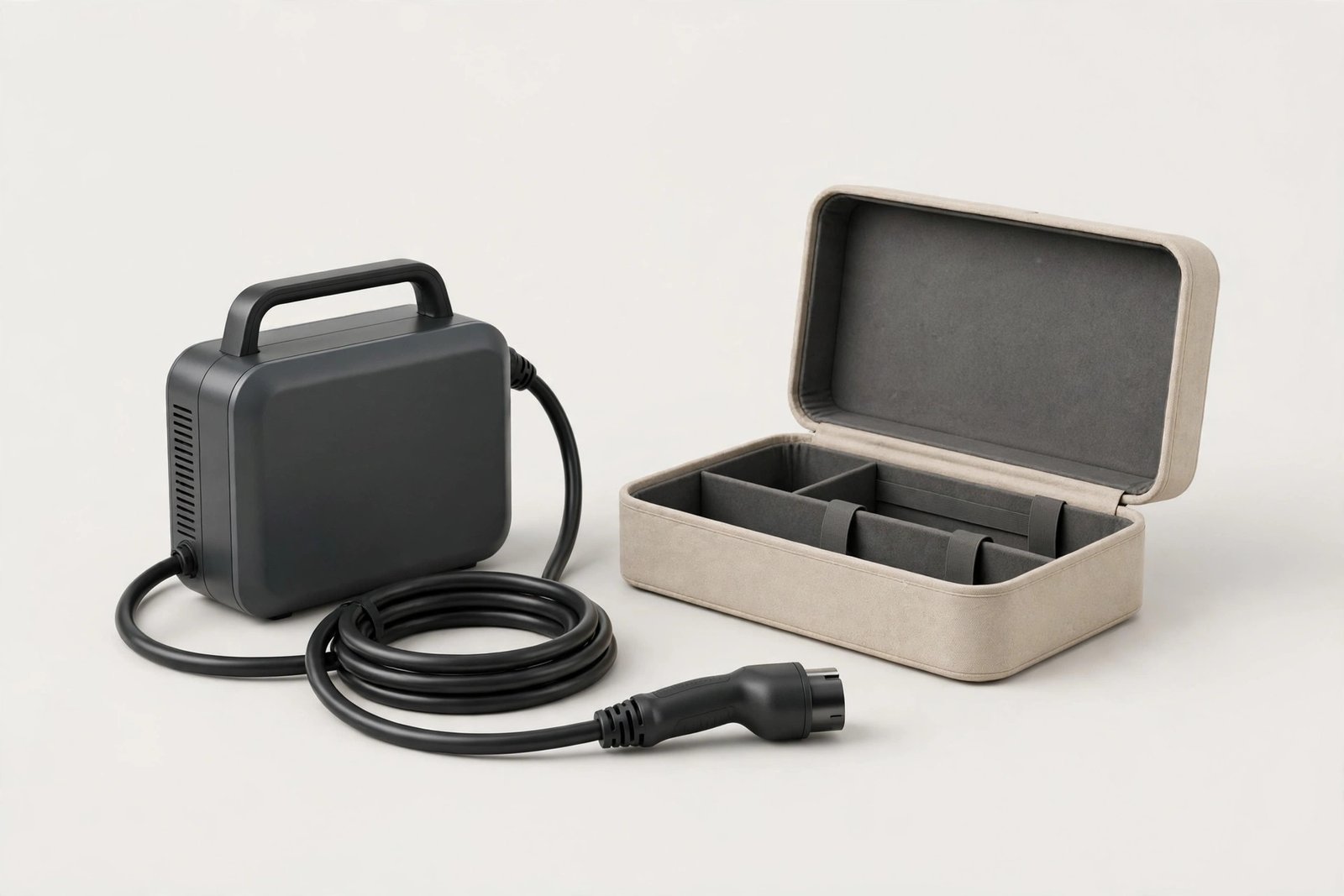
The Portable Level 2 Charger with Travel Case is the traveller of the group: a compact charging unit on a sturdy cable that plugs into a suitable high-power socket and delivers proper level 2 home charger speeds, then coils away into its case. At home it can serve as your main charger on a garage socket; on trips it earns its place at holiday cottages, relatives’ houses and workshops where a compatible socket exists.
The honest caveat is that the socket matters more than the charger. These units need the right type of heavy-duty outlet, fitted and checked by an electrician — an ordinary household socket is not a shortcut to fast charging, and adaptors should only ever be the manufacturer’s own. Used properly, though, this is the most flexible way to get overnight charging in more than one place, and a good backup even for owners with a fixed wall charger.
Pros
- Level 2 speed in a pack-away design
- Works anywhere with a suitable socket
- Carry case keeps cable and plugs tidy
- Useful backup for a fixed wall charger
Cons
- Depends entirely on having the right socket
- No wall storage, so it can feel untidy
- Fewer smart features than wall units
Best for: drivers who split time between home and a second place with a suitable socket.
Check Price And User Reviews on Amazon
5. Dual Connector Wall Charger for Two Cars

Two electric cars and one charger is a nightly negotiation nobody enjoys, and the Dual Connector Wall Charger for Two Cars ends it. One wall unit feeds two cables, splitting its available power intelligently between the cars or filling one first and then the other, depending on how you set it. Both cars stay plugged in all night, and both are ready by morning — no 11pm trip outside in slippers to swap a cable.
This is where a smart ev charger with scheduling really proves itself, because the app juggles priorities: the car with the early start charges first, the other tops up afterwards. Your electrician will size the supply carefully, since two cars can draw a lot between them, and some households pair this unit with load balancing so the house always keeps its share. For two-EV families, it is usually cheaper and neater than fitting two separate chargers.
Pros
- Charges two cars from a single unit
- No nightly cable swapping between cars
- Scheduling prioritises the car that leaves first
- Neater than fitting two separate chargers
Cons
- Shared power means slower charging when both plug in
- Higher unit cost than a single charger
- Needs a generously sized electrical supply
Best for: two-EV households that want both cars ready every morning.
Check Price And User Reviews on Amazon
6. Slim Compact Garage Wall Charger

Not every garage has a spare wall the size of a billboard. The Slim Compact Garage Wall Charger squeezes full 7kW-class charging into a narrow, shallow housing that fits between shelves, beside a door frame, or on the pillar between two parking bays. The cable is typically a little shorter than average, which suits a car that parks in the same spot every night, close to the wall.
Compact does not have to mean basic: many slim units still offer a delay timer or simple app control for off-peak charging, though you trade away some of the fancier energy reporting. During ev charger installation at home, your electrician will appreciate the straightforward mounting, and you will appreciate not walking into a bulky box every time you squeeze past the car with the shopping. Measure your wall space before ordering, and check the cable reaches your car’s charge port with room to spare.
Pros
- Narrow housing fits tight garage walls
- Full overnight charging speed despite the size
- Straightforward mounting for installers
- Less likely to be knocked when passing
Cons
- Shorter cable limits parking flexibility
- Fewer premium app features on most models
- Small displays can be harder to read
Best for: small garages where wall space is genuinely precious.
Check Price And User Reviews on Amazon
7. Solar Ready Smart Wall Charger
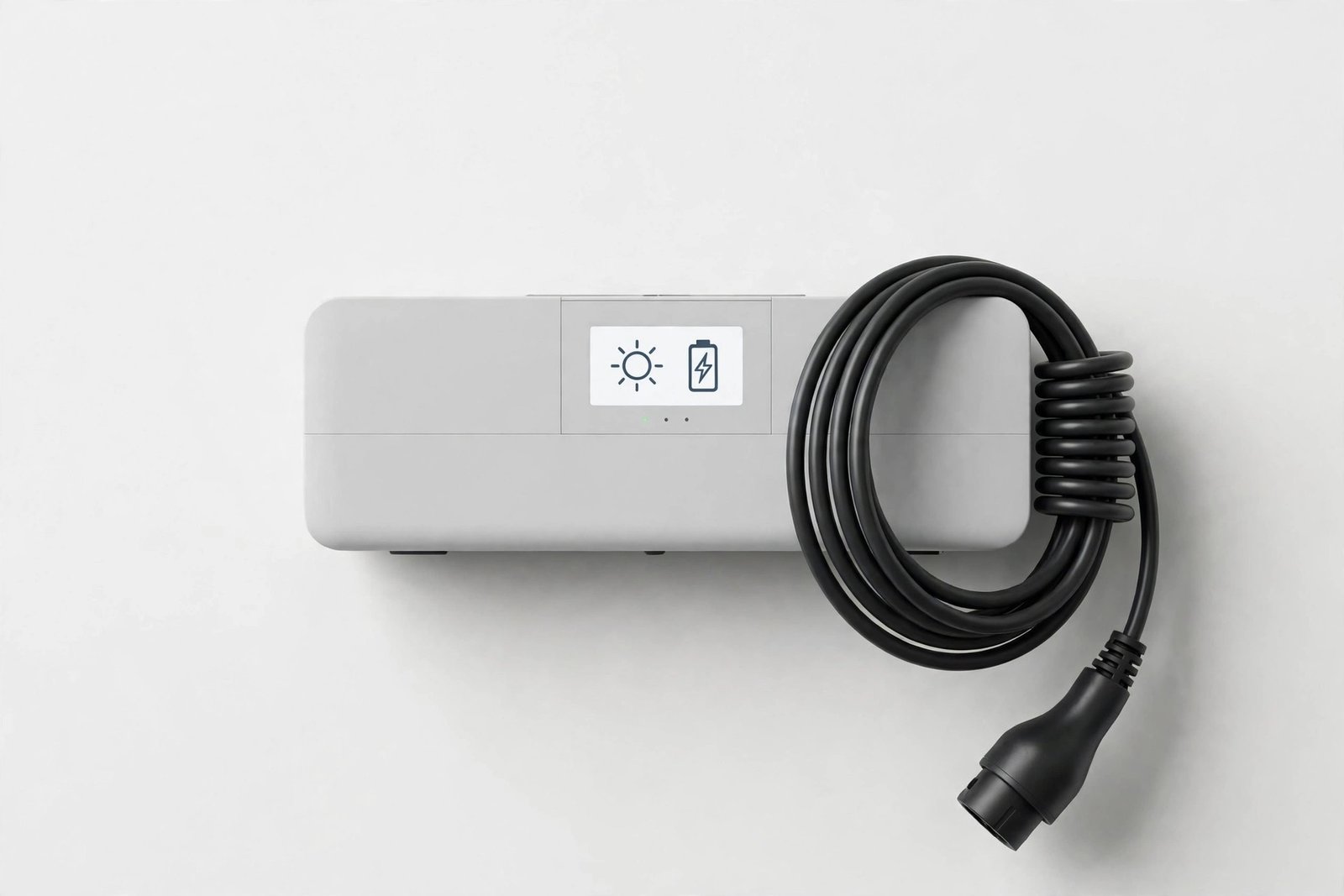
If your roof makes electricity, the Solar Ready Smart Wall Charger tries to put as much of it as possible into your car. Paired with a household energy monitor, it can vary its charging rate to soak up surplus solar power that would otherwise be exported, then top up from the grid overnight at off-peak rates so the car is still full by morning. It is the cleverest version of a smart ev charger with scheduling: sunshine first, cheap grid power second.
The honest detail is that solar charging works best when the car is home during the day, at least some days a week. Commuters who leave at dawn will mostly use the overnight scheduling instead, which this unit also handles well. Installation involves an extra current sensor near your meter, so raise it with your electrician early — retrofitting the sensor later is possible but tidier done in one visit.
Pros
- Uses surplus solar power instead of exporting it
- Blends solar charging with off-peak top-ups
- Detailed energy reports in the app
- Still a full-speed overnight charger
Cons
- Solar benefits need the car home in daylight
- Extra energy sensor adds fitting work
- Only worthwhile if you have solar panels
Best for: solar households that want the car to run on their own sunshine.
Check Price And User Reviews on Amazon
8. Heavy Duty Wall Charger with Extra Long Cable

Sometimes the wall and the car simply refuse to be near each other. The Heavy Duty Wall Charger with Extra Long Cable answers with a cable of eight metres or more, thick enough to carry full charging power over the distance, so it can serve a car parked across a wide garage, on the far side of a driveway, or in the second bay while the charger lives in the first. The cable is noticeably heavier than standard, so a proper wall holster matters.
Plan the cable route before you buy: it should reach without running across a walkway where it becomes a trip hazard, and it should never be stretched drum-tight to reach the port. Your electrician can also advise whether a second mounting point or a cable ramp makes sense for your layout. For homes where the parking spot is simply far from the house electrics, this type of level 2 home charger saves a great deal of creative parking.
Pros
- Extra long cable reaches distant parking spots
- Heavy-duty build suits busy family driveways
- Full charging power over the longer run
- One charger can serve two parking positions
Cons
- Long cable is heavy to coil every day
- Cable routing needs thought to avoid trips
- Costs more than standard-cable equivalents
Best for: wide garages and driveways where the car parks far from the wall.
Check Price And User Reviews on Amazon
9. Wall Charger with RFID Access Control

A charger on a shared driveway, a rental property or a small business forecourt has an obvious question attached: who else might plug in? The Wall Charger with RFID Access Control answers it with a tap of a card or fob. The charger stays locked until an authorised card wakes it, and the app or onboard memory keeps a record of who charged and how much energy they used — genuinely useful for landlords, Airbnb hosts and families splitting bills with a lodger.
Day to day, the tap becomes part of the routine and takes a second. Look for units that supply several cards and let you revoke a lost one easily, and check whether usage records export cleanly if you need them for expenses. Everything else about the unit is standard overnight equipment: wall mounted, weather sealed versions exist, and your electrician fits it exactly like any other fixed charger.
Pros
- Stops unauthorised use on shared driveways
- Per-card usage records simplify bill splitting
- Quick tap-to-start routine for owners
- Suits rentals, hosts and small businesses
Cons
- One more card to keep track of
- Slightly dearer than open-access equivalents
- Guests need a card issued before charging
Best for: shared driveways, rentals and hosts who need charging kept accountable.
Check Price And User Reviews on Amazon
10. Simple Wall Charger with Built-In Delay Timer

Not everyone wants another app in their life. The Simple Wall Charger with Built-In Delay Timer covers the one smart feature that actually saves money — starting the charge later — with nothing but a dial or a couple of buttons on the unit itself. Plug in at teatime, set a four-hour delay, and charging begins when the off-peak rate starts. No Wi-Fi, no account, no password to forget.
You give up energy reports and remote control, and for many owners that trade is entirely worth it; there is also less to go wrong. These units suit second homes, grandparents, and anyone whose car itself lacks a charge timer. A delay timer plus a basic tariff still captures most of the saving that a smart ev charger with scheduling offers, because the expensive hours are simply avoided. Check that the timer is easy to set with cold fingers in a dark garage — chunky controls win.
Pros
- Off-peak charging without any app or Wi-Fi
- Very simple controls anyone can use
- Fewer electronics to go wrong over time
- Often the most affordable wall charger type
Cons
- No usage reports or remote control
- Delay must be set again if plans change
- Cannot react to tariff price changes
Best for: owners who want off-peak savings with the least possible technology.
Check Price And User Reviews on Amazon
11. Adjustable Amp Wall Charger for Older Panels

Older homes often have modest electrical panels that were never designed with a car in mind. The Adjustable Amp Wall Charger for Older Panels lets your electrician set the charging current to what your home can safely spare — perhaps a gentler rate that still adds plenty of range overnight — rather than demanding the maximum on day one. If you later upgrade your panel, the same charger can be turned up to full speed.
This is a decision to make with your electrician, not on your own: they will assess the panel, the other loads in the house and the local rules, then set the charger accordingly during ev charger installation at home. Even at a reduced rate, overnight ev charging at home at, say, half speed adds far more range than most daily driving uses, so many owners never feel the limit at all. It is a pragmatic pick that avoids an expensive panel upgrade purely for the car’s sake.
Pros
- Can suit homes with smaller electrical panels
- Rate can be raised after a panel upgrade
- Gentler charging still covers daily driving
- Avoids costly electrical work in many cases
Cons
- Slower charging until the panel is upgraded
- Setting must be chosen by your electrician
- Very large batteries may not fill overnight
Best for: older homes where the electrical panel has limited spare capacity.
Check Price And User Reviews on Amazon
12. Wall Charger with Dynamic Load Balancing

The Wall Charger with Dynamic Load Balancing watches your whole house, not just your car. A sensor near the meter measures how much power the home is using moment to moment, and the charger speeds up when the house is quiet and eases off when the oven, shower and tumble dryer all run at once — so charging never pushes the main fuse near its limit. On a quiet night it delivers full speed; on a busy evening it politely takes what is spare.
For homes where a panel upgrade would be expensive or impractical, this is often the smartest money in the whole setup, and it pairs naturally with overnight ev charging at home because the small hours are when the house load is lowest anyway. The sensor is fitted by your electrician during installation, and once it is set up you never think about it again — the car simply charges as fast as the house allows, every night.
Pros
- Protects the main fuse automatically
- Full speed whenever the house is quiet
- Can avoid an expensive panel upgrade
- Works invisibly once it is installed
Cons
- Busy evenings mean temporarily slower charging
- Sensor fitting adds a little installation time
- Higher purchase cost than basic chargers
Best for: busy family homes where the car shares power with everything else.
Check Price And User Reviews on Amazon
What to Look for Before You Buy
Charging speed: match the charger to your nights
A level 2 home charger in the 7kW class adds roughly 25 to 30 miles of range per hour, and an 11kW unit adds more where the car and the supply allow. For most drivers, even the slower end refills a day’s driving in two or three hours, so overnight is generous. Check the maximum charging rate your car can actually accept before paying for speed it cannot use, and remember that your home’s supply may set its own ceiling — your electrician will tell you what is realistic.
Plug-in or hardwired?
The plug in vs hardwired ev charger decision shapes both cost and flexibility. Plug-in units connect through a dedicated heavy-duty socket, can be removed when you move, and are a natural fit for renters with permission. Hardwired units are permanently connected, look neater, avoid a plug connection that needs periodic checks, and are the usual choice outdoors. Neither is automatically better — the right answer depends on your home, your parking and how long you plan to stay.
Scheduling and off-peak tariffs
If your electricity tariff has cheaper overnight hours, scheduling is the feature that pays you back. A smart ev charger with scheduling automates the whole thing and adds energy reports; a simple delay timer captures most of the same saving for less money. Check whether the charger, your car, or both can set the schedule — you only need one of them to do it — and make sure the charger keeps its settings through a power cut.
Cable length and everyday handling
Measure from the charger’s likely position to your car’s charge port, in the way you actually park, then add a little slack. A cable that only just reaches will annoy you every single night, while an overly long one is heavy to coil. Look for a proper holster or hook, a connector that is comfortable to grip, and status lights you can read at a glance in the dark. These small handling details decide whether charging feels like a pleasure or a chore.
Installation and safety, planned properly
Budget for ev charger installation at home as part of the purchase, not an afterthought. A qualified electrician will assess your consumer unit, advise whether load balancing or an adjustable-amp charger suits your panel, run the correct cable, and certify the work under your local electrical codes. Do not be tempted by DIY wiring guides or socket adaptors: a charger pulls heavy current for hours, and professional fitting is what makes overnight charging genuinely worry-free. Follow the manufacturer’s guidance on use, and have the installation checked if anything ever looks or smells unusual.
Final Thoughts
The best home ev chargers for electric car owners charging overnight share one quality: they disappear into your routine. For most homes that means a wall-mounted level 2 home charger with scheduling that matches the electricity tariff, a cable that reaches comfortably, and a professional installation you never have to think about again. Add load balancing or adjustable amps if your home’s electrics are modest, and access control if your driveway is shared.
Start by talking to a qualified electrician about your panel and parking layout, then choose the charger type that fits their advice and your tariff. Do that, and overnight ev charging at home becomes the easiest part of owning an electric car — plug in after dinner, wake up to a full battery, and simply drive.
More Guides You’ll Like
Once the charger is sorted, the rest of the car kit deserves the same care: Best Gadgets for Car Lovers Under $100 rounds up the upgrades drivers actually enjoy, Best Smart Home Gadgets Under $100 covers the connected kit that pairs well with a smart garage, and Best Car Gadgets for Road Trips is worth a read before your first long journey on home-charged miles.
Frequently Asked Questions
How long does overnight charging actually take?
With a level 2 home charger, most cars recover a typical day’s driving in two to four hours, and even a large battery that arrives home nearly empty will usually fill within a single night at 7kW to 11kW. That is why overnight ev charging at home works so well: the car has eight or more hours parked, and the charger rarely needs all of them. Very large batteries on an adjustable charger set to a gentle rate are the main exception worth planning around.
Do I really need an electrician to fit a home charger?
Yes. A home charger needs a dedicated circuit sized for hours of heavy current, and fitting it is regulated electrical work in most places. A qualified electrician will check your consumer unit, advise on capacity, complete the ev charger installation at home safely, and provide the certification your insurer and local rules may require. Plug-in models still need their socket fitted and checked professionally. It is money well spent for something that runs unattended every night.
Is a smart charger worth it over a simple one?
It depends on your tariff. On an off-peak tariff, a smart ev charger with scheduling can cut the cost of every mile by starting charges automatically at the cheapest hours, and its reports make the saving visible. On a flat-rate tariff, a simple charger with a delay timer — or scheduling built into the car — may do everything you need. Decide from your electricity bill, not from the feature list.
Can I charge two electric cars from one supply?
Usually, yes. A dual connector charger shares one unit between two cars, and dynamic load balancing can share power between the car and the house so the main fuse is never overloaded. Your electrician will confirm what your supply can support and whether the cars charge together at reduced speed or take turns overnight. For most two-car households, either approach still leaves both cars ready by morning.