Best Compression Packing Cubes for Travellers Packing Two Weeks in Carry-On
Affiliate Disclosure: As an Amazon Associate, we earn from qualifying purchases made through links on this page, at no extra cost to you. This helps support our work and keeps our guides free to read.
A quick note on prices: prices change often, so we never quote a fixed price here. Please check the latest price on Amazon before you buy, using the yellow buttons in this guide. The product pictures in this article are original illustrations created for this guide, not manufacturer photos.
Two weeks of clothes in a single carry-on sounds like a magic trick, but it is really just arithmetic: roll, compress, and stop packing air. The best compression packing cubes for travellers packing two weeks in carry-on trips earn that name because they squeeze the wasted space out of soft clothes, so fourteen days of outfits fold down into the footprint of a case that still fits the overhead bin. Done well, packing cubes for two weeks of clothes stop being a squeeze and become a system: one cube per clothing type, each one compressed flat, stacked like books.
The difference between ordinary cubes and compression packing cubes for carry-on travel is the second zip. A normal cube just organises; a compression cube has an extra zip that runs around the middle and pulls the sides together, pressing out air as you close it, so a cube of jumpers ends up noticeably thinner than it started. That thinning is what buys you the extra outfits: across a full set, travellers typically fit several more days of clothing than loose packing allows, without sitting on the case to close it.
Two expectations are worth setting before you buy. Compression saves space, not weight: the same clothes weigh the same however tightly you squeeze them, and a densely packed carry-on can creep over an airline’s cabin weight limit even when it looks small. Size rules vary just as much between airlines, so build your set around the smallest case you actually fly with. Construction matters too: double zip compression cubes put real strain on their zips and seams every single trip, which is why this guide favours reinforced stitching, smooth-running zips and fabrics that shrug off two weeks of being opened daily. Get the case size and the construction right, and you have already solved most of how to pack a carry-on for two weeks.
Inside, the picks are organised the way a two-week case actually packs: a full set to start with, large cubes for bulky layers, slim cubes for tops, see-through mesh for finding things fast, and dedicated cubes for shoes and laundry so clean and worn clothes never share air. Whether your method is rolling everything or folding flat, these are the space saving packing cubes for travel that turn a bulging carry-on into a tidy grid. One phrase worth stealing before the list: think in outfits per cube, not items per drawer.
How We Chose
We compared cube sets the way a two-week traveller actually uses them: filled with real outfit maths — roughly fourteen tops, several bottoms, underwear and sleepwear — then compressed, stacked in a standard carry-on shell and checked for gaps. Sets that only compressed when half empty were marked down, as were cubes whose zips strained, snagged fabric or needed two hands and a knee to close.
We also weighed the details that decide whether a set survives a whole trip: zip quality, seam stitching, fabric weight, and how the set handles shoes and dirty laundry, because two weeks means managing worn clothes as well as clean ones. Every pick below works with rolling or flat folding, and none needs a vacuum or pump.
Quick List
- Six-Piece Compression Cube Set for Carry-On — the complete carry-on grid in one purchase.
- Ultralight Double-Zip Compression Cubes (Set of 4) — serious compression that barely registers on the scales.
- Large Compression Cube for Jumpers and Coats — presses the loft out of bulky layers.
- Slim Compression Cubes for T-Shirts and Tops (Set of 3) — rolled tops in flat, stackable slabs.
- Mesh-Top Compression Packing Cubes (Set of 5) — see every outfit without unzipping a thing.
- Water-Resistant Compression Cube Set with Shoe Bag — shrugs off spills, damp towels and beach days.
- Compression Shoe Cubes (Pair) — seals dirty soles away and flattens shoe bulk.
- Hanging Compression Packing Cube with Hooks — unpacks into shelves in tiny rooms.
- Compression Laundry Cube with Odour-Resistant Lining — keeps week two smelling like week one.
- Extra-Long Compression Cube for Trousers and Dresses — full-length storage with fewer creases.
- Structured Compression Cubes with Rigid Sides (Set of 3) — a rigid, stackable core for hard-shell cases.
- Roll-Up Compression Travel Bags (Set of 6) — maximum squeeze for the last awkward items.
1. Six-Piece Compression Cube Set for Carry-On

If you own no cubes at all, start here. A Six-Piece Compression Cube Set for Carry-On gives you the full grid in one purchase — typically two large, two medium and two small cubes, every one with the extra compression zip — sized so the set fills a standard carry-on shell edge to edge. As a first set of compression packing cubes for carry-on travel it removes the guesswork: larges take trousers and jumpers, mediums take tops, and the smalls swallow underwear and socks.
The graduated sizing is the real feature: the cubes stack without the awkward gaps odd-sized cubes leave, and the whole case lifts out in blocks at security or in a small hotel room. Check the set’s stated dimensions against your case’s interior before ordering — a set built for a larger case will fight a smaller cabin bag — and look for size markings printed on each cube, which make mid-trip repacking far less of a puzzle.
Pros
- 👍 Complete matched set in one purchase
- 👍 Sizes designed to fill a carry-on shell
- 👍 Compression zips on every cube
- 👍 Easy system for first-time cube users
Cons
- 👎 Fixed size mix may not suit every wardrobe
- 👎 One colour throughout can blur categories
- 👎 Large cubes too big for slim cabin bags
Best for: first-time cube buyers who want the whole system in one box.
Check Price And User Reviews on Amazon
2. Ultralight Double-Zip Compression Cubes (Set of 4)
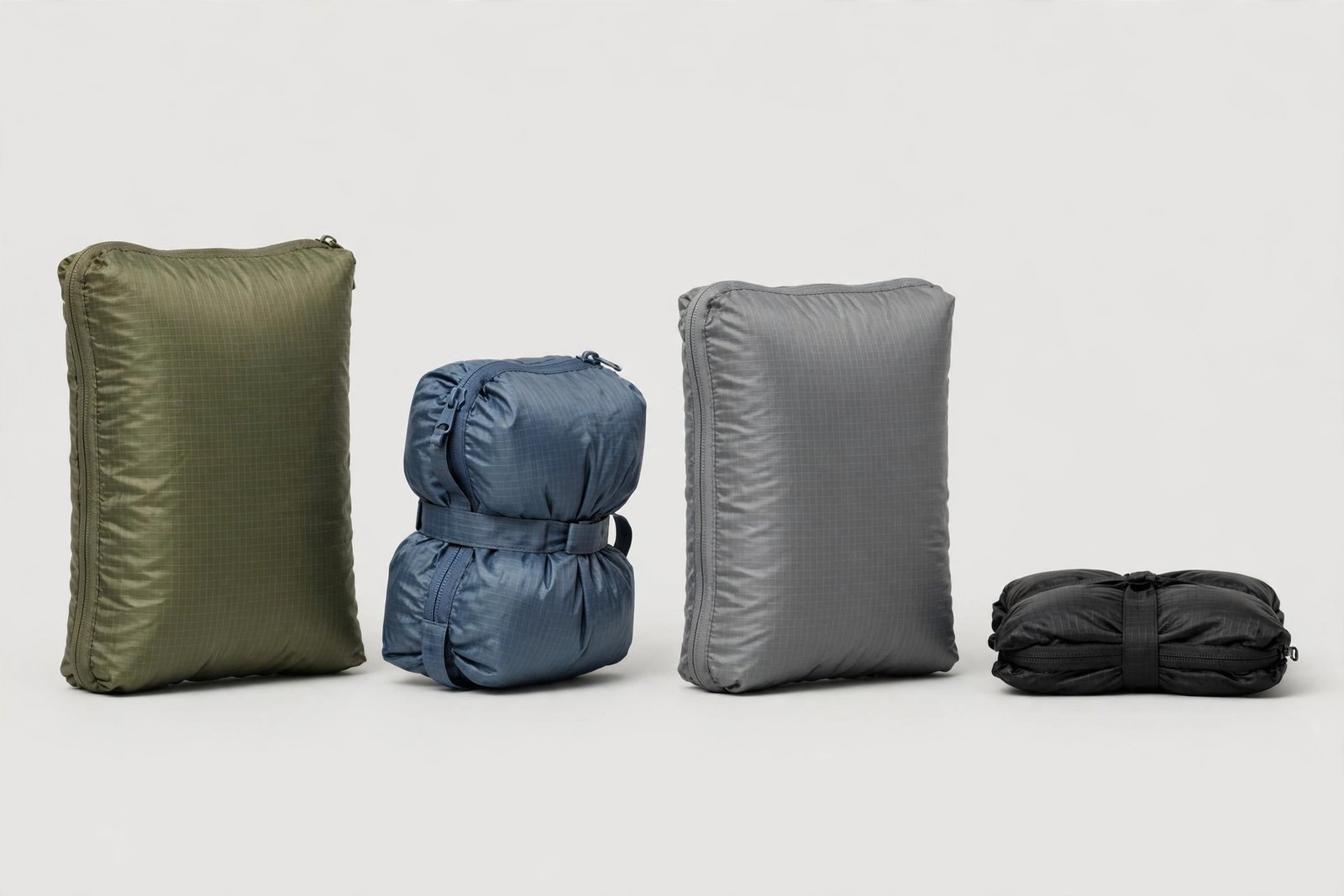
Weight-watchers, start here. The Ultralight Double-Zip Compression Cubes are cut from thin ripstop-style fabric that adds almost nothing to the scales, which matters when packing cubes for two weeks of clothes already pushes a cabin bag towards the airline’s weight limit. The double zips do the heavy lifting: pack the cube, close the main zip, then run the second zip around to press the contents down by roughly a third.
The trade-off for the light weight is structure — these cubes are floppy when empty and lean on their neighbours once packed, so they suit travellers who fill every cube completely. Four medium-large cubes is a versatile count for two weeks: two for tops, one for bottoms, one for everything small. Compress in two passes instead of forcing the last inch in one pull, and ultralight zips last for years.
Pros
- 👍 Featherweight fabric protects your weight allowance
- 👍 Strong compression from the second zip
- 👍 Ripstop material resists tearing
- 👍 Packs flat when not in use
Cons
- 👎 Little structure when half empty
- 👎 Zips need a gentle two-pass technique
- 👎 No mesh panel to identify contents
Best for: travellers close to the cabin weight limit who pack every cube full.
Check Price And User Reviews on Amazon
3. Large Compression Cube for Jumpers and Coats
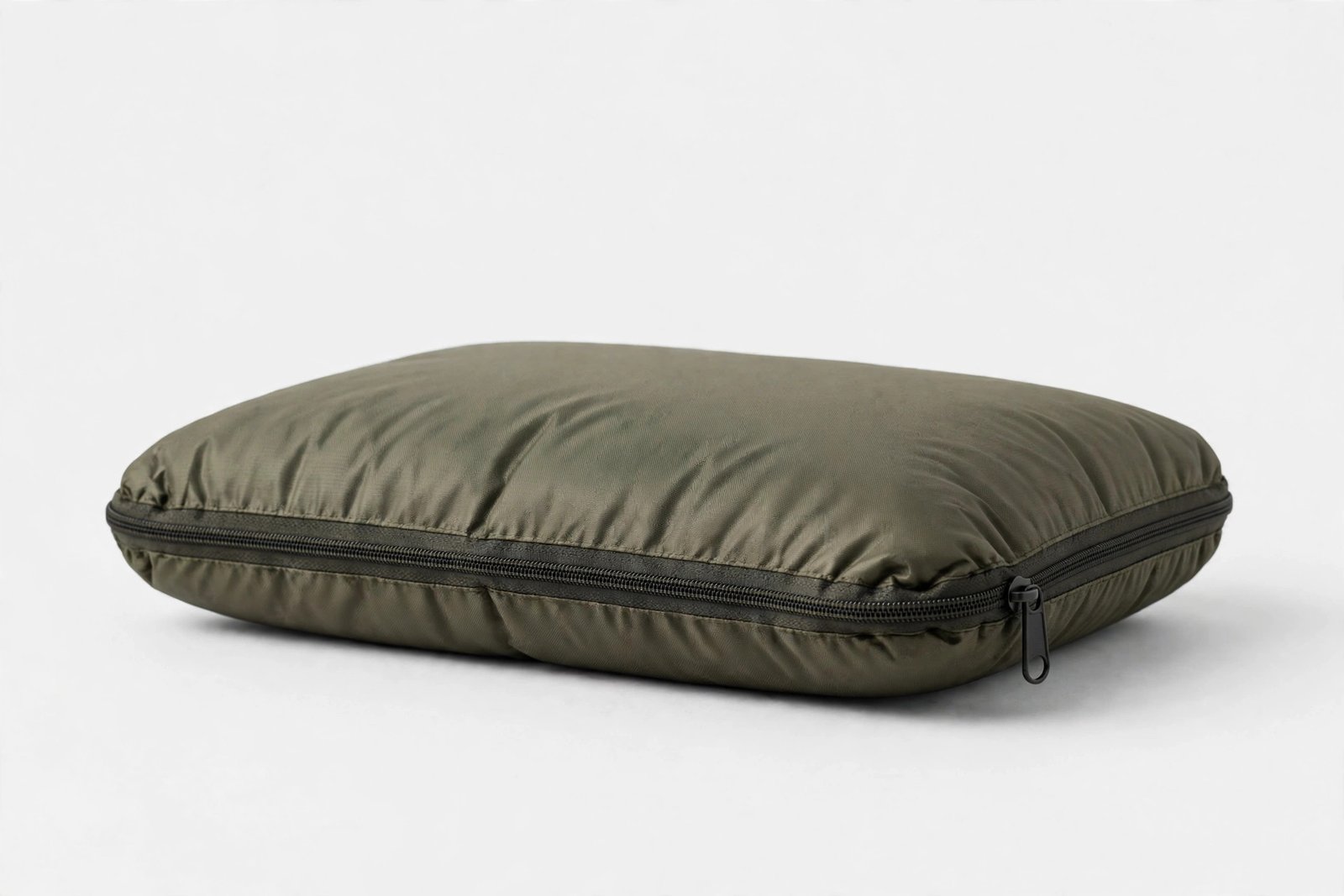
Bulky layers are where two-week trips go to die, and the Large Compression Cube for Jumpers and Coats is built for exactly that problem. Sized to take two or three chunky jumpers, a fleece and a light jacket, it uses its compression zip to press the loft out of knitwear — the single biggest space saving in the whole case, because jumpers are mostly trapped air.
Use it as the base layer of the case: compressed flat, it forms a firm floor that everything else stacks on. Two checks before buying: the cube’s footprint should match your case’s width so it sits square, and the fabric should be smooth inside so knitwear slides in without snagging on the zip tape.
Pros
- 👍 Tames the bulkiest items in the case
- 👍 Forms a flat base layer for stacking
- 👍 Ideal for winter and shoulder-season trips
- 👍 Smooth lining protects knitwear
Cons
- 👎 One big cube is less flexible than two mediums
- 👎 Heavy when fully loaded
- 👎 Too deep for very slim cabin cases
Best for: cold-weather travellers whose jumpers and coats eat the case.
Check Price And User Reviews on Amazon
4. Slim Compression Cubes for T-Shirts and Tops (Set of 3)
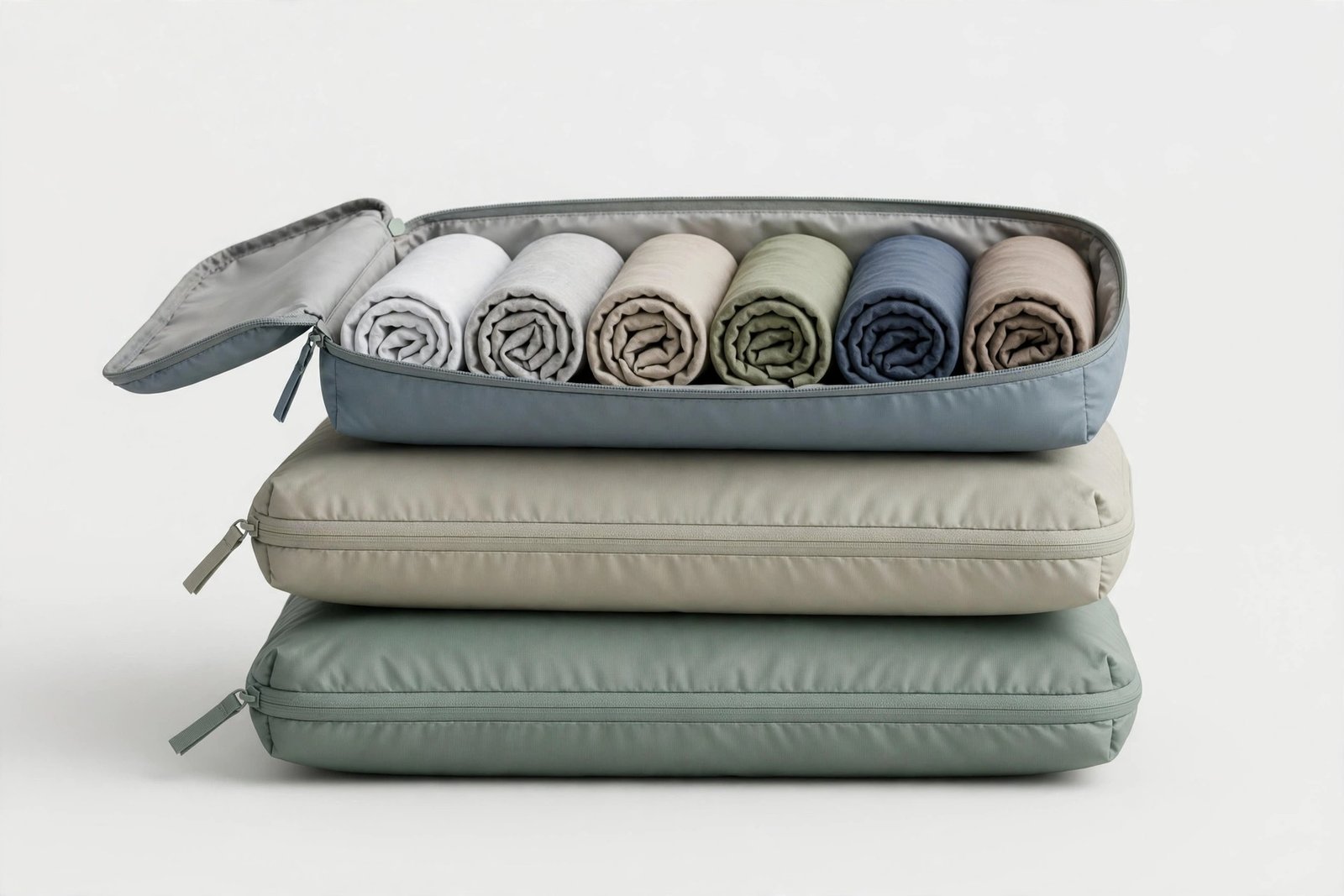
Tops are the volume problem in a two-week wardrobe — fourteen of them, even rolled — and the Slim Compression Cubes for T-Shirts and Tops answer it with shape rather than brute force. These are long, shallow double zip compression cubes that take rolled t-shirts in a single row, then compress into flat slabs that stack like books along one side of the case.
The single-row layout is the point: you can see and pull any shirt without excavating a deep cube, and three slabs divide cleanly into everyday tops, smarter tops and sleepwear. Roll shirts tightly before loading — compression works on the roll, and a sloppy roll just compresses into a sloppy slab.
Pros
- 👍 Single-row layout keeps every top visible
- 👍 Flat slabs stack neatly and fill gaps
- 👍 Three cubes sort tops into clear groups
- 👍 Great for rolled packing styles
Cons
- 👎 Too shallow for chunky knitwear
- 👎 Rolling is essential, folding wastes the shape
- 👎 Set covers tops only, not a full wardrobe
Best for: rollers who pack lots of t-shirts and tops for two weeks.
Check Price And User Reviews on Amazon
5. Mesh-Top Compression Packing Cubes (Set of 5)
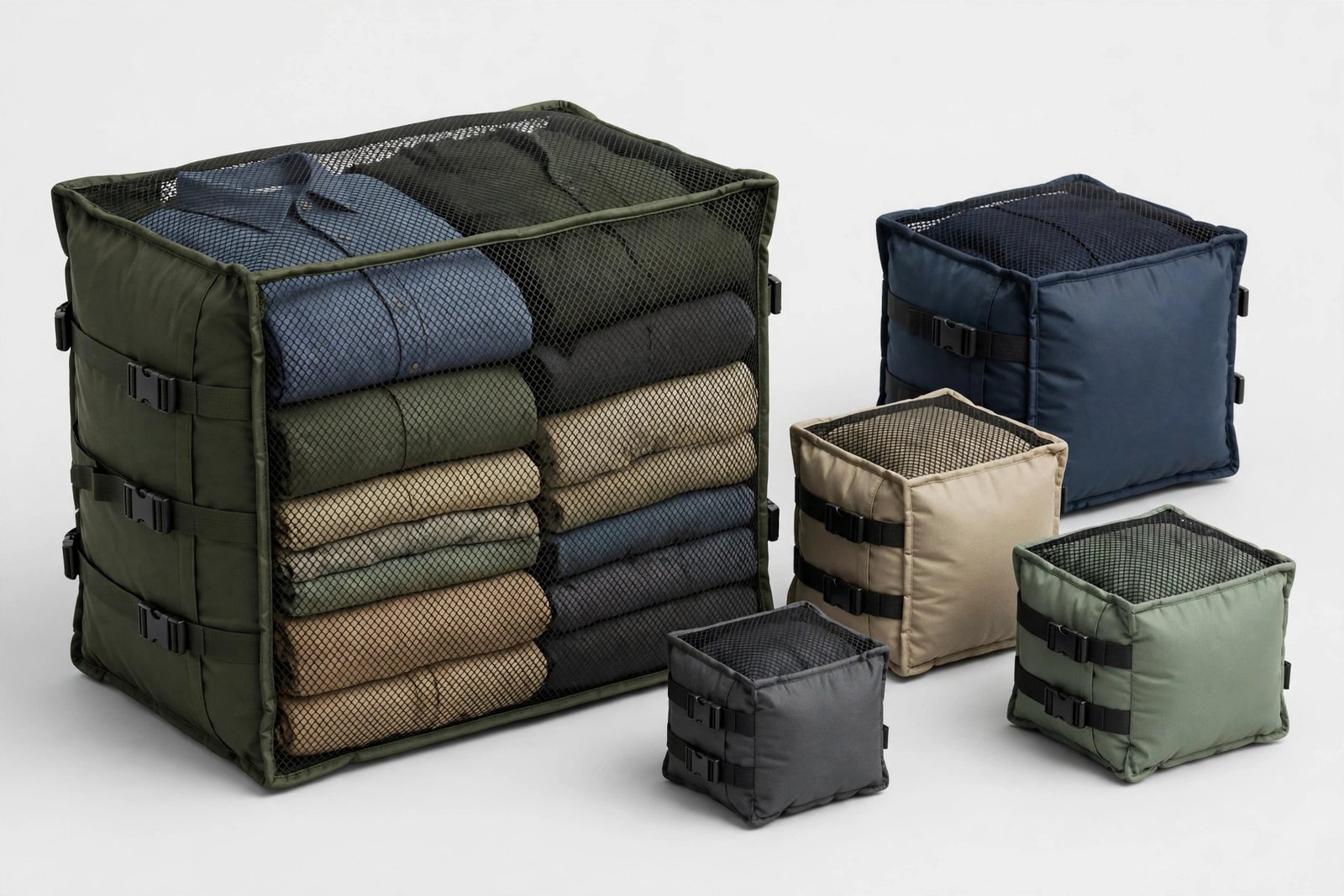
If you hate unzipping every cube to find one shirt, the Mesh-Top Compression Packing Cubes are your set. A breathable mesh panel across the top lets you identify contents at a glance and lets air move through the case, which keeps clothes smelling fresher across a long trip. Among compression packing cubes for carry-on use, mesh versions are the easiest to live with day to day, because you open the right cube first time, every time.
Mesh does cost a little rigidity — the panel flexes, so these compress slightly less crisply than solid fabric — and it is worth choosing fine, tight-weave mesh that will not catch on zips or buttons. Keep laundry in a separate sealed cube rather than a mesh one. Five mixed sizes cover a full two-week wardrobe for most packers, with the smallest cube doubling as an underwear organiser.
Pros
- 👍 See contents without opening the cube
- 👍 Breathable panels keep clothes fresher
- 👍 Mixed sizes cover a whole wardrobe
- 👍 Easy daily living on long trips
Cons
- 👎 Mesh flexes, so compression is less crisp
- 👎 Not the right home for dirty laundry
- 👎 Fine mesh needed to avoid snags
Best for: travellers who live out of their case and hate the unzip-everything hunt.
Check Price And User Reviews on Amazon
6. Water-Resistant Compression Cube Set with Shoe Bag

Beach weeks, festival trips and rainy city breaks share one fear: a wet or leaking something meeting fourteen days of clean clothes. The Water-Resistant Compression Cube Set with Shoe Bag answers with coated fabric that shrugs off spills, damp towels and a shampoo incident, plus a separate shoe bag so soles never touch fabric. It is also a tidy answer to how to pack a carry-on for two weeks when the itinerary mixes swims, hikes and dinners out.
Water-resistant is not waterproof: a cube left sitting in a puddle will eventually let moisture through the zips, so truly soaked items still belong in a proper dry bag inside the cube. The coating also makes the fabric slightly stiffer, which some packers love and others find less forgiving in a tight case. Check that the shoe bag genuinely fits your shoe size — some bundled bags are optimistic about anything over a mid-size trainer.
Pros
- 👍 Coated fabric shrugs off spills and damp
- 👍 Separate shoe bag keeps soles off clothes
- 👍 Suits beach, festival and mixed itineraries
- 👍 Slightly structured fabric stacks well
Cons
- 👎 Resistant, not fully waterproof at the zips
- 👎 Stiffer fabric is less forgiving to pack
- 👎 Bundled shoe bag can run small
Best for: trips mixing beach days, wet weather and smarter clothes in one case.
Check Price And User Reviews on Amazon
7. Compression Shoe Cubes (Pair)
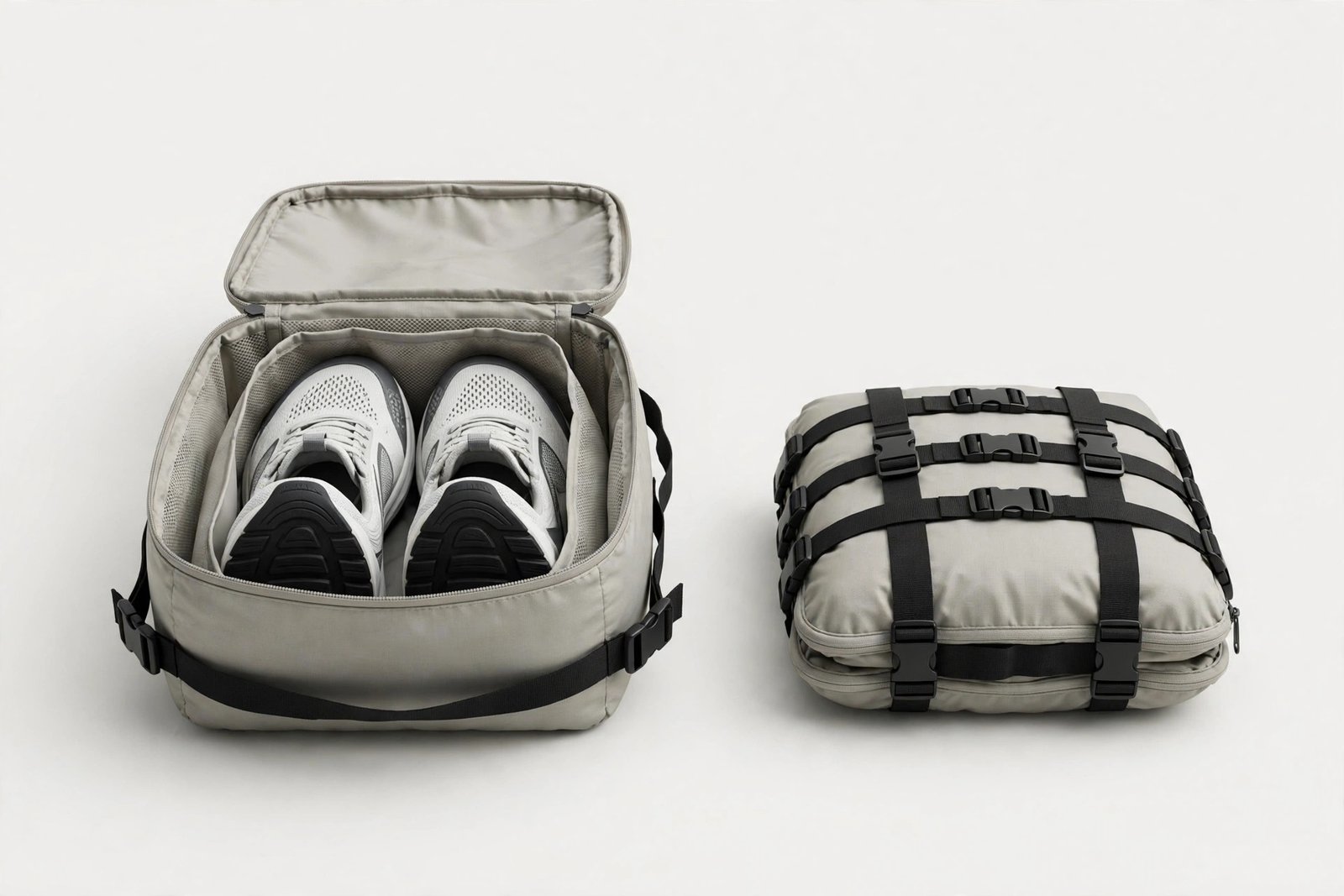
Shoes are the worst-shaped items in any case: rigid, dirty-soled and full of wasted space inside. A pair of Compression Shoe Cubes corrals them properly — one pair per cube, soles to the outside walls, with a compression zip that flattens the cube around the shoes instead of letting them roam. When packing cubes for two weeks of clothes are handling the clothing, shoe cubes finish the system: a spare pair of trainers and a smarter pair, each sealed in its own block.
Pack socks and small soft items inside the shoes themselves first — that hollow space is free storage most people waste. Place shoe cubes along the case’s wheel edge or spine, where their weight and rigidity do no harm, rather than against soft cubes they can crush unevenly. Measure your largest pair against the cube’s stated length; boots usually still need to be worn on the plane, not packed.
Pros
- 👍 Seals dirty soles away from clothing
- 👍 Compression flattens awkward shoe bulk
- 👍 Sock storage inside shoes wastes nothing
- 👍 Keeps pairs together and easy to grab
Cons
- 👎 Boots rarely fit — measure before buying
- 👎 Adds weight at the case’s edge
- 👎 One pair per cube means buying multiples
Best for: travellers packing two spare pairs of shoes for a long trip.
Check Price And User Reviews on Amazon
8. Hanging Compression Packing Cube with Hooks
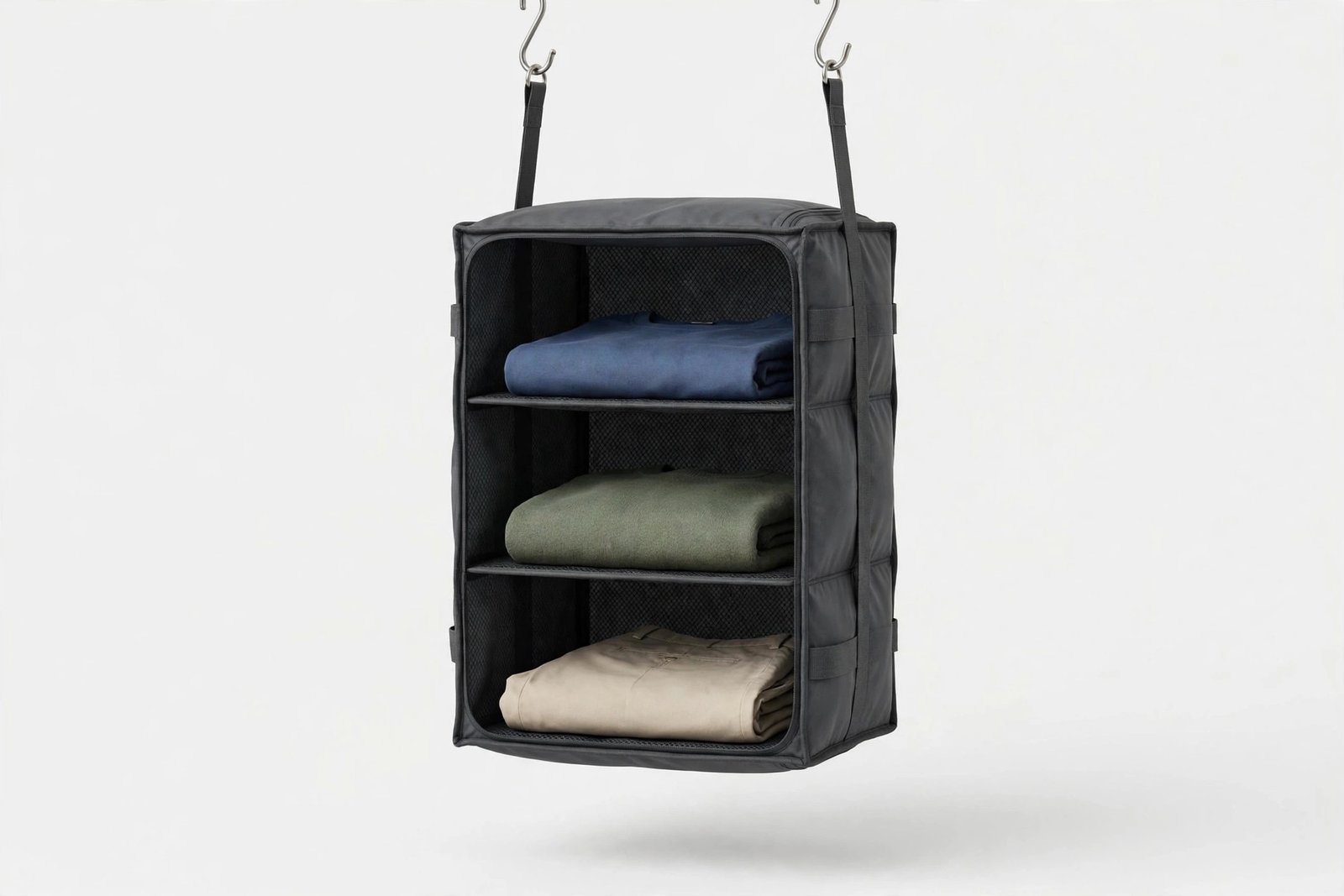
Small hotel rooms and hostel bunks share a problem: nowhere to unpack. The Hanging Compression Packing Cube with Hooks solves it by turning one cube into portable shelves — pack it like a cube, compress it for the case, then hang it from a wardrobe rail or door hook at the other end and live out of its open compartments. As double zip compression cubes go, it works harder than most: transport and storage in a single item.
It earns its place on trips with several short stops, where full unpacking never happens, and in rooms where the only flat surface is the bed. The honest trade-offs are weight and shape: hooks and shelf structure add grams, and a hanging cube is usually one larger unit rather than a flexible set, so pair it with one or two plain cubes for underwear and laundry. Check the hooks tuck away flat so they cannot snag other cubes inside the case.
Pros
- 👍 Becomes hanging shelves on arrival
- 👍 Perfect for multi-stop trips and tiny rooms
- 👍 No unpacking onto questionable surfaces
- 👍 Compresses flat like a normal cube
Cons
- 👎 Hooks and structure add weight
- 👎 One large unit is less flexible than a set
- 👎 Hanging shape suits tops more than bulky layers
Best for: multi-stop travellers and anyone staying in very small rooms.
Check Price And User Reviews on Amazon
9. Compression Laundry Cube with Odour-Resistant Lining

By day ten of a two-week trip, the dirty-clothes problem is bigger than the clean-clothes problem. The Compression Laundry Cube with Odour-Resistant Lining gives worn clothes their own sealed, compressing home, so smells stay behind the lining and the laundry pile shrinks as fast as the clean cubes empty. It is the least glamorous of these compression packing cubes for carry-on travel, and quite possibly the one you will appreciate most by the second week.
The system works in mirror image: every morning, yesterday’s clothes move into the laundry cube and it gets one notch tighter, keeping the case the same size from the first day to the last. Choose a lining that wipes clean and a cube that opens wide — you will use it daily, often in a hurry.
Pros
- 👍 Seals smells away from clean clothes
- 👍 Compresses the growing laundry pile
- 👍 Keeps the case the same size all trip
- 👍 Wipe-clean lining is easy to maintain
Cons
- 👎 Needs emptying and airing after the trip
- 👎 Lined fabric can feel stiff
- 👎 Two compartments cost more than one
Best for: any two-week traveller — the clean-and-dirty divide makes the whole system work.
Check Price And User Reviews on Amazon
10. Extra-Long Compression Cube for Trousers and Dresses

Most cubes are sized for folded tops, which leaves trousers and dresses creased around awkward folds. The Extra-Long Compression Cube for Trousers and Dresses matches the full length of a carry-on instead, so long items fold once, lengthwise, and lie flat under gentle compression. It is a quiet cornerstone of how to pack a carry-on for two weeks when the wardrobe includes smart trousers, longer dresses or a blazer you actually care about.
Lay it at the very bottom or very top of the case as a full-length layer — bottom for structure, top if you will need the smart outfit first. Gentle is the word: close the compression zip only partway for delicate fabrics. If your case is a smaller cabin size, measure its interior length before ordering, because an extra-long cube that overhangs the edges helps nobody.
Pros
- 👍 Full-length shape suits trousers and dresses
- 👍 One lengthwise fold means fewer creases
- 👍 Forms a neat full-case layer
- 👍 Gentle compression setting for delicate items
Cons
- 👎 Too long for the smallest cabin cases
- 👎 One-purpose shape packs fewer small items
- 👎 Crease-free results still depend on fabric choice
Best for: travellers packing smart trousers, dresses or a blazer for long trips.
Check Price And User Reviews on Amazon
11. Structured Compression Cubes with Rigid Sides (Set of 3)

Soft cubes make soft luggage softer; the Structured Compression Cubes with Rigid Sides do the opposite, holding a clean rectangular shape even when half full. That rigidity makes them the easiest cubes to stack in a hard-shell case and the easiest to pull in and out at security, and it protects crushable things — a hat, a presentable shirt, a gift — far better than fabric alone. For packing cubes for two weeks of clothes in a hard case, three structured cubes make an excellent rigid core to build around.
The cost is adaptability: rigid sides cannot squeeze into odd corners, and the set weighs more than ultralight equivalents, so use them as the frame of the case and fill the leftover gaps with soft cubes or rolled items. They also double as drawer organisers between trips. Check whether the side panels flatten for storage if cupboard space is tight at home.
Pros
- 👍 Hold their shape for perfect stacking
- 👍 Protect crushable items inside the case
- 👍 Easy to slide in and out at security
- 👍 Double as home drawer organisers
Cons
- 👎 Cannot squeeze into odd gaps
- 👎 Heavier than ultralight cubes
- 👎 Less suited to soft duffel-style cases
Best for: hard-shell case owners who like a tidy, rigid packing grid.
Check Price And User Reviews on Amazon
12. Roll-Up Compression Travel Bags (Set of 6)
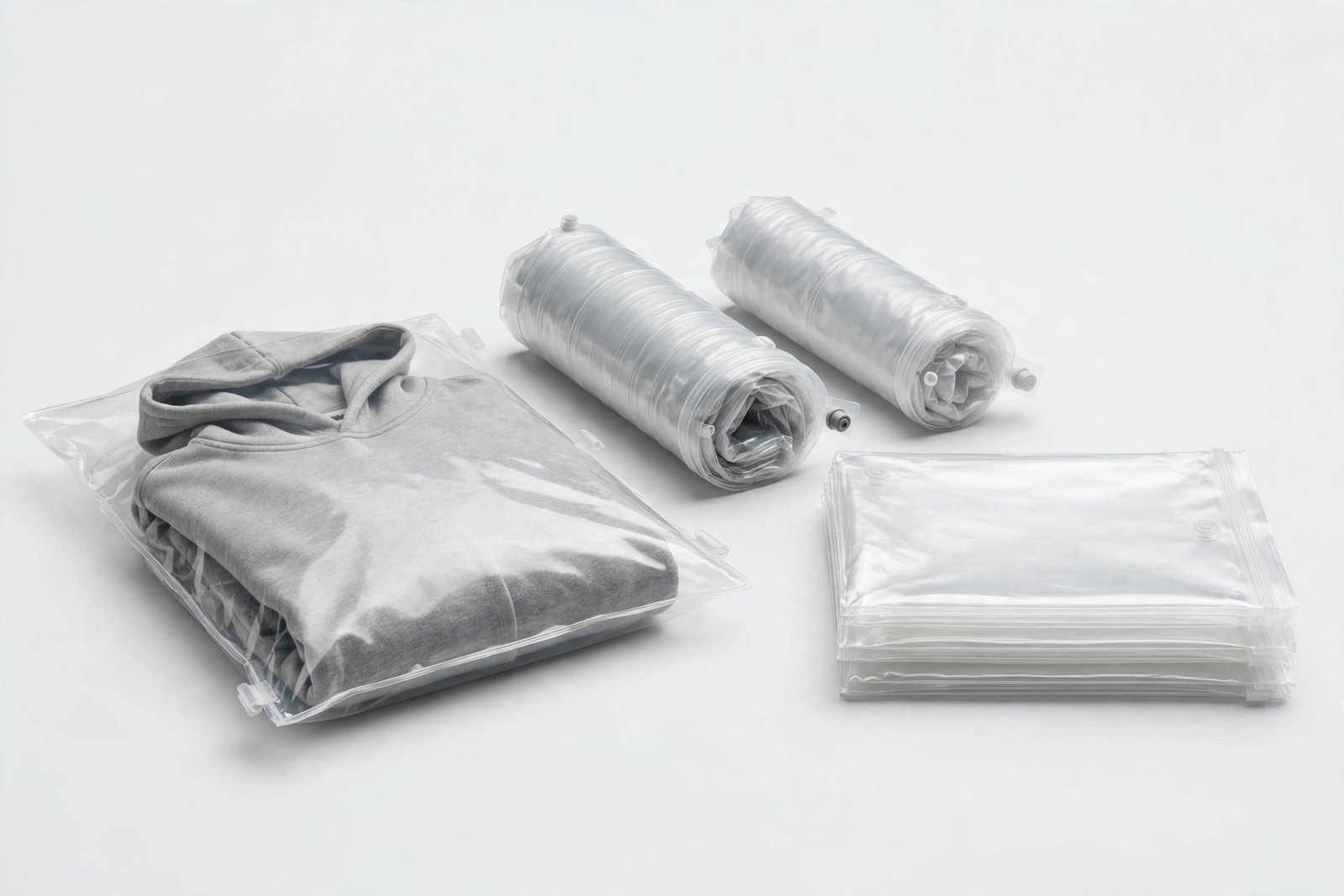
The last awkward five per cent of any case — the hoodie, the beach towel, the just-in-case layer — is where Roll-Up Compression Travel Bags earn their keep. These clear bags need no vacuum: load one, seal it, and roll it towards the one-way valve to push the air out, leaving a flat, firm parcel that slides into whatever gap remains. Among space saving packing cubes for travel, they compress the furthest of anything here — exactly why they are a supporting tool rather than the main system.
Used for everything, they turn packing into wrestling and clothes come out creased, so reserve them for soft, forgiving items and for the trip home, when dirty clothes and souvenirs compete for the same case. The valves and seals are the wear points — roll from the sealed end, keep grit off the zip track, and retire a bag when it stops holding its roll.
Pros
- 👍 Strongest compression of any pick here
- 👍 No vacuum or pump needed
- 👍 Clear plastic shows contents instantly
- 👍 Brilliant for the trip home and souvenirs
Cons
- 👎 Clothes emerge more creased than from cubes
- 👎 Seals and valves wear with heavy use
- 👎 Not a full packing system on their own
Best for: squeezing bulky soft items and solving the coming-home space problem.
Check Price And User Reviews on Amazon
What to Look for Before You Buy
Match the set to your case, not the product photo
Product photos make every set look universal, and no set is. Measure the inside of the case you actually fly with — length, width and depth with the lid closed — and compare those numbers with the cube dimensions in the listing, especially the largest cube. Airline carry-on allowances differ between a standard cabin case and a budget airline’s smaller sizer, so build your grid around the smallest case you use regularly.
Understand what compression does — and what it does not
Compression removes air, not weight, and understanding that is most of how to pack a carry-on for two weeks successfully. The clothes still weigh what they weigh, so if your airline enforces a cabin weight limit, compress the volume-hungry light items — jumpers, fleeces, tops — and wear the heaviest piece on the plane. Remember too that compression packing cubes for carry-on travel only work on soft goods: shoes, toiletries and hard items do not shrink, so give them fixed corners of the case and compress the clothing around them.
Zips and seams carry the whole system
Every compression cycle loads the zips and seams, so this is where cheap sets fail first. Look for double zip compression cubes with reinforced stitching, grippy zip pulls, and a track that runs smoothly around corners. Then use them properly: fill the cube, close the main zip, rest a hand flat on top and walk the compression zip around in two passes. Forcing the final stretch in one pull is how teeth separate and seams pop, usually mid-trip.
Choose fabrics for the trip you are taking
Fabric decides how a set behaves day to day. Mesh panels trade a little rigidity for visibility and airflow, which suits long trips where you live out of the case. Solid lightweight fabrics compress the most crisply and weigh the least. Coated, water-resistant fabrics protect against spills but feel stiffer in a tight case. Most two-week travellers end up happiest with a mix: one solid set as the base, one mesh or special-purpose cube on top.
Plan for laundry from day one
A two-week case is a system with two halves: clean clothes shrinking and worn clothes growing. If laundry has no planned home, it ends up folded back in with the clean cubes by day five, and the organisation quietly collapses. Decide before you buy where dirty clothes and shoes will live — a lined laundry cube and a shoe cube between them cost little space, because both compress.
Final Thoughts
The real secret is giving every category of clothing one compressed home and keeping clean and dirty apart. Start with a matched set or a structured core, add the specialists your wardrobe needs — slim cubes for tops, a large cube for layers, one cube each for shoes and laundry — and those packing cubes for two weeks of clothes will hold the same tidy shape on day thirteen as on day one.
Pick the best compression packing cubes for travellers packing two weeks in carry-on trips by fit, by build quality, and by whether the system matches how you travel — the same way you would pick the case itself. Choose well, and space saving packing cubes for travel become the reason a fortnight’s wardrobe rides in the overhead bin while everyone else queues at the carousel.
More Guides You’ll Like
Once the case is organised, the rest of the trip gets easier too. Our guide to the Best Travel Gadgets for Long International Flights covers the comfort kit that makes the long haul bearable, while Best Compact Gadgets for Van Life Road Trips on a Budget applies the same small-space thinking to life on the road. And because two weeks away means keeping phones alive throughout, Best Portable Chargers for Travel rounds up the power banks worth a corner of your case.
Frequently Asked Questions
Can you really pack two weeks of clothes in a carry-on?
Yes, with outfit maths rather than hope. Re-wear trousers and layers, pack tops as the variable, choose a palette where everything mixes, and let compression remove the air that makes fourteen outfits look impossible. The honest summary of how to pack a carry-on for two weeks is: fewer, better-chosen clothes, every one rolled or folded into a cube, and one laundry cube so the system survives the second week.
Do compression cubes save weight as well as space?
No — and this is the most common misunderstanding. Compression squeezes out air, so the case gets smaller, not lighter; the same jumpers weigh the same before and after the second zip closes. If your airline weighs cabin bags, weigh yours at home after packing, and move the heaviest item — usually shoes or a coat — into your worn outfit for the flight.
Is it better to roll or fold clothes in compression cubes?
Both work, and the best answer depends on the cube. Rolling suits t-shirts, underwear and casual layers, and it fills slim cubes perfectly with no wasted corners. Folding flat suits trousers, dresses and smarter shirts, especially in extra-long or structured cubes where the shape rewards a single neat fold. Many experienced packers do both in the same case — rolled everyday clothes in the main cubes, folded smart pieces in one flat layer — and compression then presses out whatever air the method leaves behind.
How many packing cubes do I need for two weeks?
For most travellers, a set of five or six cubes covers the clean wardrobe, and two specialists finish the system: one cube for shoes and one for laundry. That grid fills a standard carry-on in tidy layers, with toiletries in the gaps. If you are choosing between more cubes and better cubes, choose better — well-made space saving packing cubes for travel with strong zips outlast several cheap sets, and a failed zip in week two is the one packing problem you cannot improvise around.