
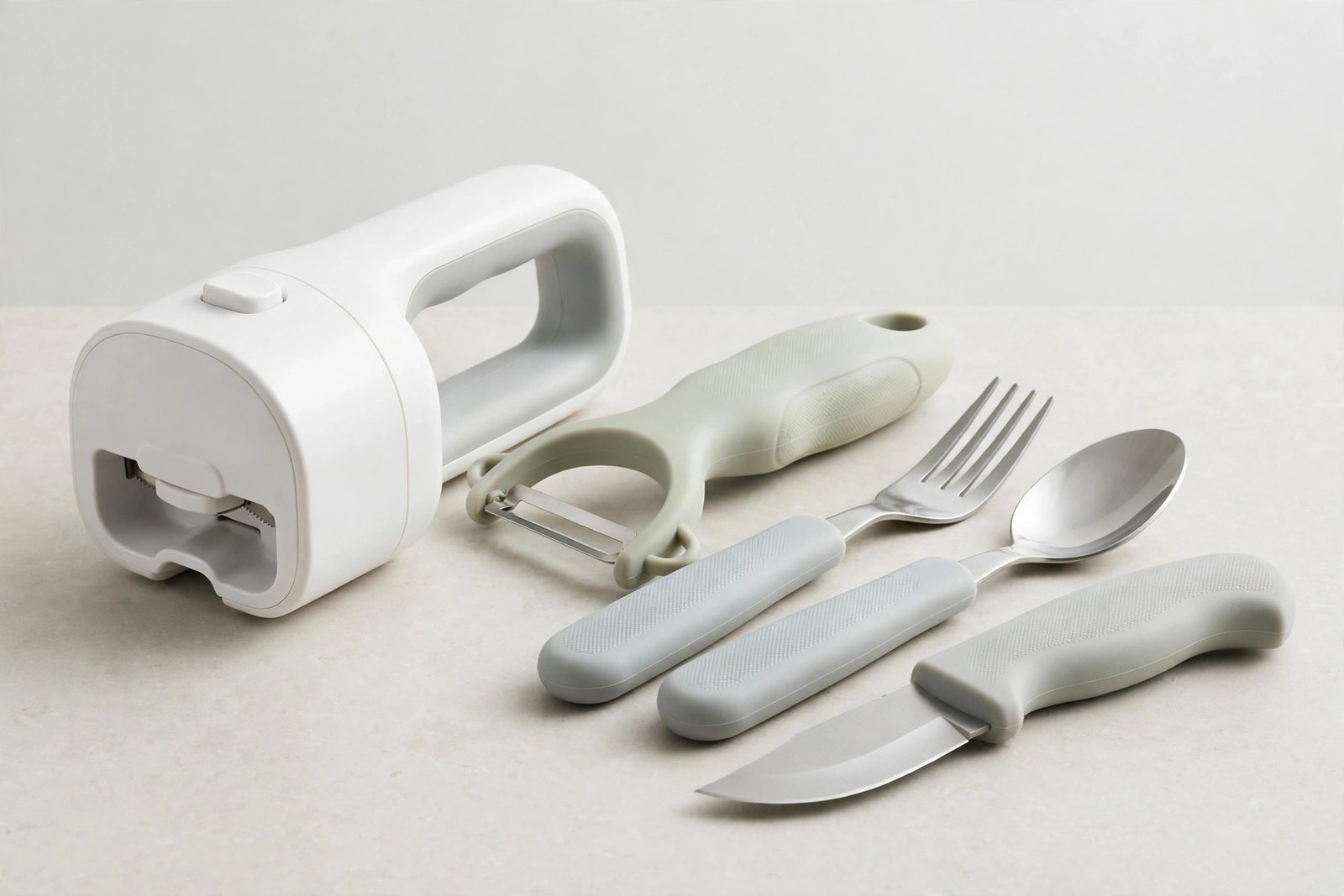
Best Easy Grip Kitchen Gadgets for Arthritis: 12 Comfortable Tools That Make Cooking Easier on Sore Hands
As an Amazon Associate, we earn from qualifying purchases made through links on this page, at no extra cost to you. This helps support our work and keeps our guides free to read.
A quick note on prices: prices change often, so we never quote a fixed price here. Please check the latest price on Amazon before you buy, using the yellow buttons in this guide. The product pictures in this article are original illustrations created for this guide, not manufacturer photos.
Introduction
If cooking has slowly started to hurt — stiff fingers first thing in the morning, a grip that gives up halfway through a jar lid, wrists that ache after ten minutes of chopping — you are not looking for novelty. You are looking for the best easy grip kitchen gadgets for arthritis: ordinary kitchen tools redesigned so they stop asking sore hands to twist, pinch, squeeze and lift. The cooking itself was never the problem. The handles were.
This guide rounds up twelve arthritis kitchen tools, each one picked because it removes a specific painful hand action rather than because it looks clever in a listing. Opening, peeling, chopping, stirring, pouring and even eating all demand something different from your hands, so the list is organised around those actions. Match the picks to the moments that hurt you most, and whole parts of cooking quietly become comfortable again.
Some of these picks are easy grip kitchen utensils — the familiar peeler, knife and cutlery rebuilt with thick, cushioned handles that spread the pressure across your whole hand. Others are adaptive kitchen tools that take your hands out of the job almost entirely: openers that twist for you, a kettle you never lift, a stirrer that stirs while you sit down. Between the two styles, nearly every painful kitchen action has an easier alternative.
We have been honest about the trade-offs, too. Electric tools need batteries or charging, chunky handles take more drawer space, and no single gadget suits every hand — arthritis is personal, and a flare-up day is different from a good day. But the right kitchen gadgets for arthritic hands do something bigger than save effort: they keep you cooking for yourself, which is worth more than any single meal.
How We Chose
We chose these twelve products by asking one question of each candidate: what painful hand action does this remove, and how often does that action happen? A gadget earned its place if the action is a daily one — twisting a lid, pinching a peeler, lifting a kettle — and if the relief is obvious from the very first use. Anything that still secretly needed a strong pinch grip, two fully able hands, or a fiddly setup was left out.
We also favoured wide, soft, non-slip handles over thin ones, large one-touch buttons over small switches, and the lightest design that still does the job properly. Finally, we spread the picks across the whole cooking day — opening and prep first, cooking and pouring in the middle, eating and seasoning at the end — so the list reads like a walk through making a meal with each painful moment removed.
Quick List
- Electric Can Opener — one press opens tins with no twisting or squeezing at all.
- Electric Jar Opener — grips and twists stubborn lids at the touch of a button.
- Ergonomic Vegetable Peeler — a chunky cushioned handle that peels without the pinch grip.
- Rocker Knife — chops with a gentle rocking motion instead of wrist force.
- Easy Grip Cutlery Set — built-up handles that make every meal easier to hold.
- Kettle Tipper — pours boiling water without ever lifting the kettle.
- Automatic Pan Stirrer — stirs sauces and soups so your wrist does not have to.
- One-Handed Cutting Board — spikes hold food steady while you chop or spread.
- Electric Pepper Mill — fresh ground pepper from one light button press.
- Foam Grip Utensil Handles — slide onto your own utensils to make any handle chunky.
- Multi-Size Jar and Bottle Opener — leverage instead of grip strength for lids and caps.
- Non-Slip Gripper Mat — holds bowls and boards still so one hand can do the work.
1. Electric Can Opener
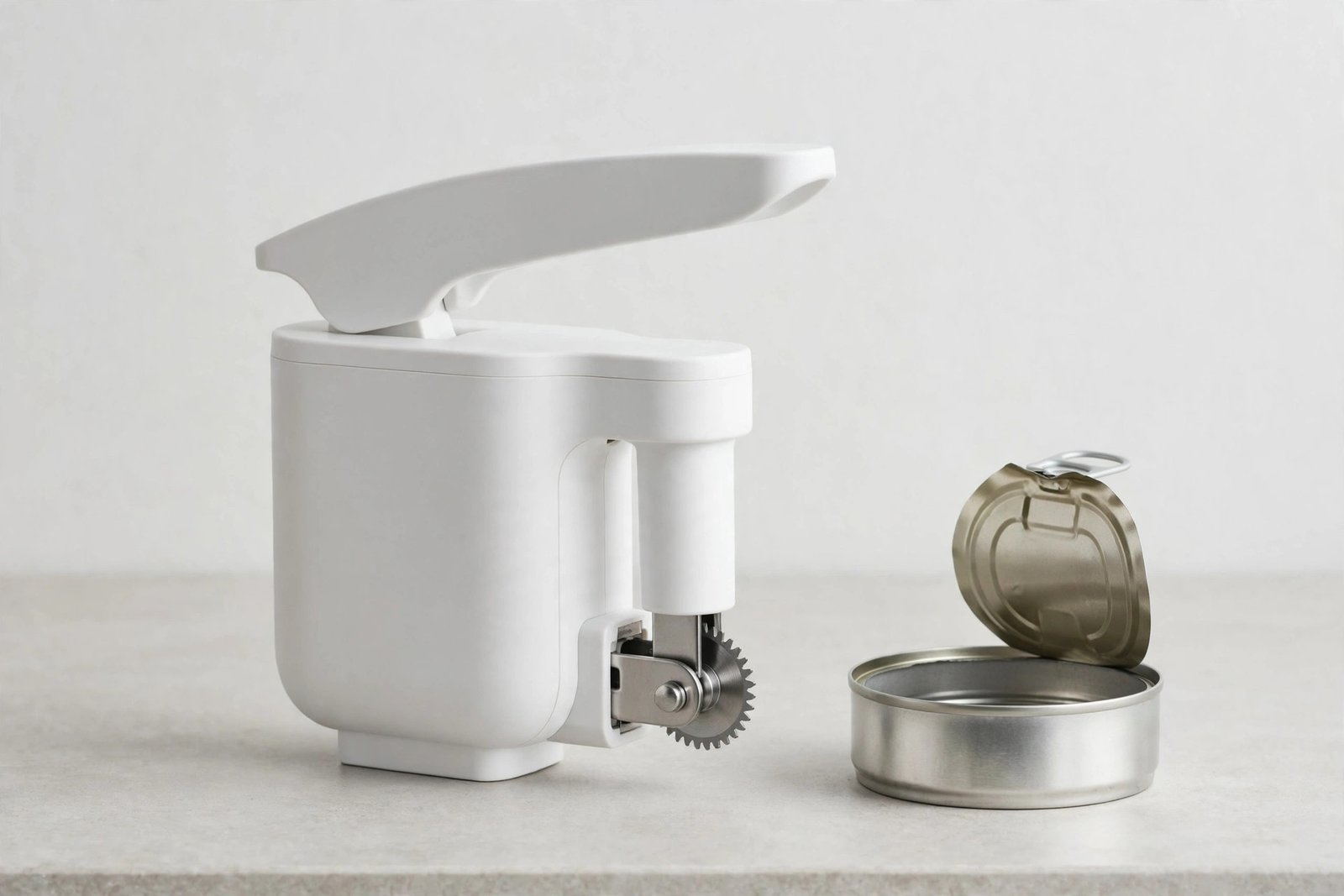
An Electric Can Opener does the whole job with one press of a large top lever: it locks onto the rim, travels around the can by itself, and lifts the lid away cleanly, magnet and all. There is no handle to squeeze, no knob to twist and no manual cutting wheel to fight — the three hand actions that make tins so miserable for arthritic fingers simply disappear.
It earns its place because tins are daily food: soup, beans, tomatoes, tuna, pet food. Most models cut just inside the rim so the lid has no jagged edge, and the magnet holds the lid so you never fish it out of the food with sore fingers. Keep it near the counter edge where tins get opened, and opening a can goes back to being a two-second job instead of the task you plan your grip around. Of all the arthritis kitchen tools in this guide, this is the one people most often say they should have bought years earlier.
Pros
- 👍 One press opens the whole can — no squeezing or twisting.
- 👍 Lid lifts away on a magnet, so no fishing with sore fingers.
- 👍 Smooth-edge cut leaves no jagged lid to handle.
- 👍 Plug-in and cordless versions suit any kitchen layout.
Cons
- 👎 Struggles with badly dented or oddly shaped cans.
- 👎 Needs counter space or a regular charging spot.
- 👎 Cutting head needs a rinse after messy foods.
Best for: anyone who dreads tin lids, cooks with canned staples, or has lost grip strength in both hands.
Check Price And User Reviews on Amazon
2. Electric Jar Opener
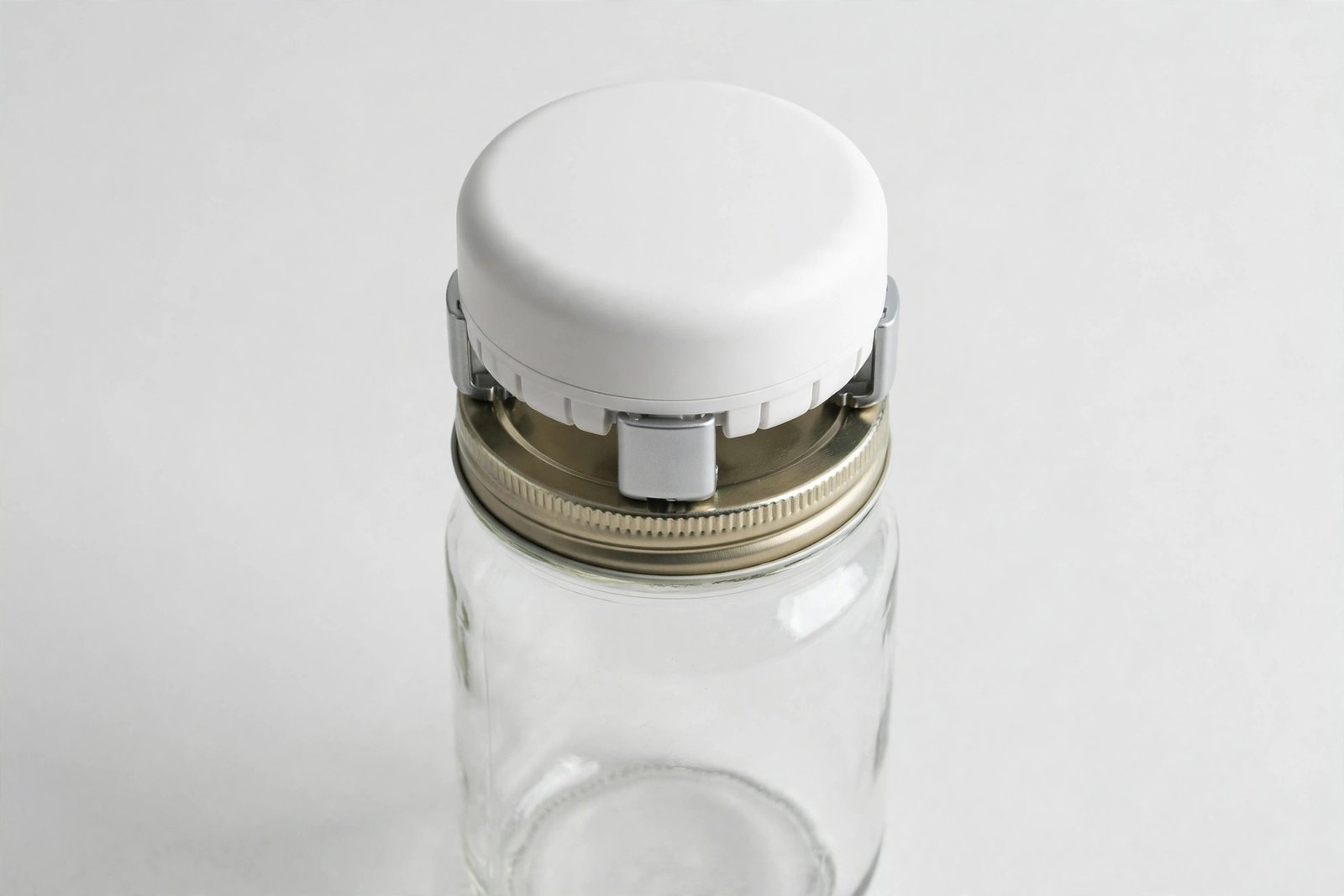
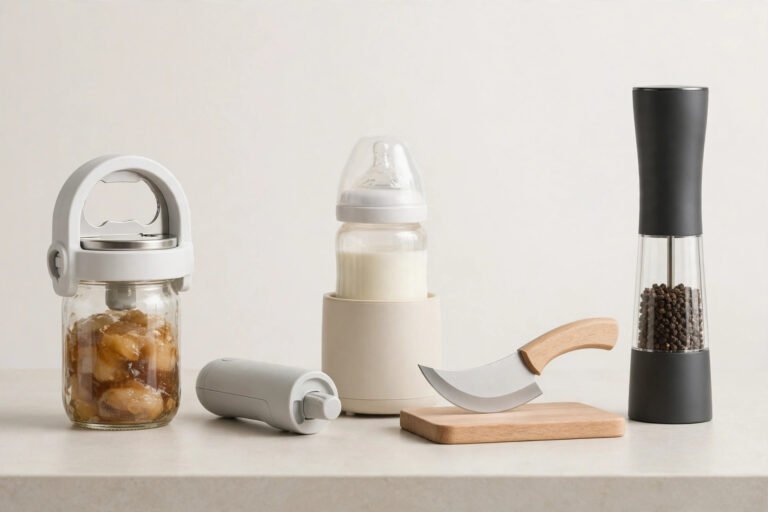
An Electric Jar Opener is a compact dome that sits on top of a jar, grips the lid with one ring and the jar body with another, and twists the lid open at the touch of a button. The machine supplies the torque your hands cannot, so jam, pickles, pasta sauce and peanut butter stop being a daily wrestling match — or a reason to wait for someone else to come home.
It adjusts to a wide range of lid sizes, from small jam jars up to big pickle jars, and it works on new factory-sealed lids as well as ones that were closed too tightly last time. In practice it is one-handed — set it on, press, lift it off — which suits cooks whose other hand is busy or also sore. Store it in a drawer near the fridge, and the single most common frustration in an arthritic kitchen quietly disappears.
Pros
- 👍 Opens stubborn and factory-sealed lids with one button.
- 👍 Adjusts to most common jar and lid sizes.
- 👍 Effectively one-handed — no gripping with either hand.
- 👍 Compact enough for a standard kitchen drawer.
Cons
- 👎 Very tall or very wide jars may not fit under it.
- 👎 Battery models feel weaker as the batteries fade.
- 👎 Gripping jaws need an occasional wipe to grip well.
Best for: anyone who has ever run a jar under hot water, banged it on the counter, or waited for help to start dinner.
Check Price And User Reviews on Amazon
3. Ergonomic Vegetable Peeler

An Ergonomic Vegetable Peeler keeps the familiar swivel blade but replaces the thin handle with a fat, cushioned, non-slip grip that fills your palm. That one change matters more than it sounds: peeling normally demands a hard pinch grip on a skinny handle, and a built-up handle spreads the force across the whole hand, so potatoes, carrots and apples get peeled with a fraction of the ache.
Look for a slightly oval handle shape with a soft, textured finish — it stays put in wet hands without you clamping down on it. The blade should swivel freely so the edge follows the vegetable instead of your wrist doing the steering. This is one of the cheapest tools in the guide and, for many people, the most used, three meals a day. If your current peeler is the thin metal kind from a supermarket multipack, this single swap is the easiest upgrade among all the easy grip kitchen utensils you can make.
Pros
- 👍 Chunky cushioned handle removes the painful pinch grip.
- 👍 Non-slip texture works even with wet hands.
- 👍 Swivel blade follows the vegetable, sparing your wrist.
- 👍 Cheap, light and usually dishwasher friendly.
Cons
- 👎 Wide handle takes more drawer space than a slim peeler.
- 👎 Soft grips wear faster if left soaking in water.
- 👎 Some left-handers prefer a fixed-blade style instead.
Best for: everyday cooks who peel vegetables daily and feel it in their thumb and fingers.
Check Price And User Reviews on Amazon
4. Rocker Knife

A Rocker Knife replaces the up-and-down sawing of a normal knife with a smooth rocking motion: the curved blade rolls through the food while the wide handle sits over the top, so your arm does the work and your wrist and fingers mostly just steer. It is brilliant for herbs, garlic, nuts, pizza and cooked vegetables — the soft-to-medium foods that make up most home chopping.
Because the handle is gripped from above with a relaxed fist rather than pinched around a slim neck, people with very stiff fingers often find it far more comfortable than a standard chef’s knife. Pair it with a board that holds food still — see the one-handed cutting board below — and together they make a genuinely one-handed chopping station. Be honest about its limits, though: it is a prep knife for softer foods, not the tool for raw squash or hard root vegetables, where an electric food processor is the kinder option.
Pros
- 👍 Rocking motion replaces wrist force and sawing.
- 👍 Top handle suits a relaxed fist grip.
- 👍 Fast and comfortable for herbs, garlic and soft veg.
- 👍 Works well one-handed with the right board.
Cons
- 👎 Not suited to hard vegetables like raw squash.
- 👎 Curved blade takes a few uses to get used to.
- 👎 Sharpens differently from straight knives.
Best for: cooks with wrist pain or stiff fingers who still chop herbs and vegetables daily.
Check Price And User Reviews on Amazon
5. Easy Grip Cutlery Set

An Easy Grip Cutlery Set is ordinary cutlery — knife, fork, spoon, often a teaspoon too — rebuilt with thick, softly cushioned handles that are far easier to hold onto. Eating is the one kitchen activity nobody can delegate three times a day, and when standard cutlery keeps slipping or digging into sore joints, every meal becomes an effort. Built-up handles fix that quietly, without looking like medical equipment.
Good sets balance the extra handle weight so the spoon does not tip out of the bowl, and many handles are gently contoured for a natural grip. They are simply table cutlery, so they travel: take your own set to a restaurant or a family dinner and the meal is comfortable there too. If a full set feels like a big step, start with the spoon and fork you use most. Among kitchen gadgets for arthritic hands, these are the least glamorous and arguably the most dignity-preserving — they just let dinner feel normal again.
Pros
- 👍 Thick cushioned handles stop slipping and digging in.
- 👍 Makes every meal easier, three times a day.
- 👍 Looks like ordinary cutlery, not a medical aid.
- 👍 Portable — take your own set anywhere.
Cons
- 👎 Chunkier handles do not fit every cutlery tray slot.
- 👎 Some sets are noticeably heavier than standard cutlery.
- 👎 Foam-style handles may need hand washing to last.
Best for: anyone whose cutlery slips, twists or hurts to hold at mealtimes.
Check Price And User Reviews on Amazon
6. Kettle Tipper
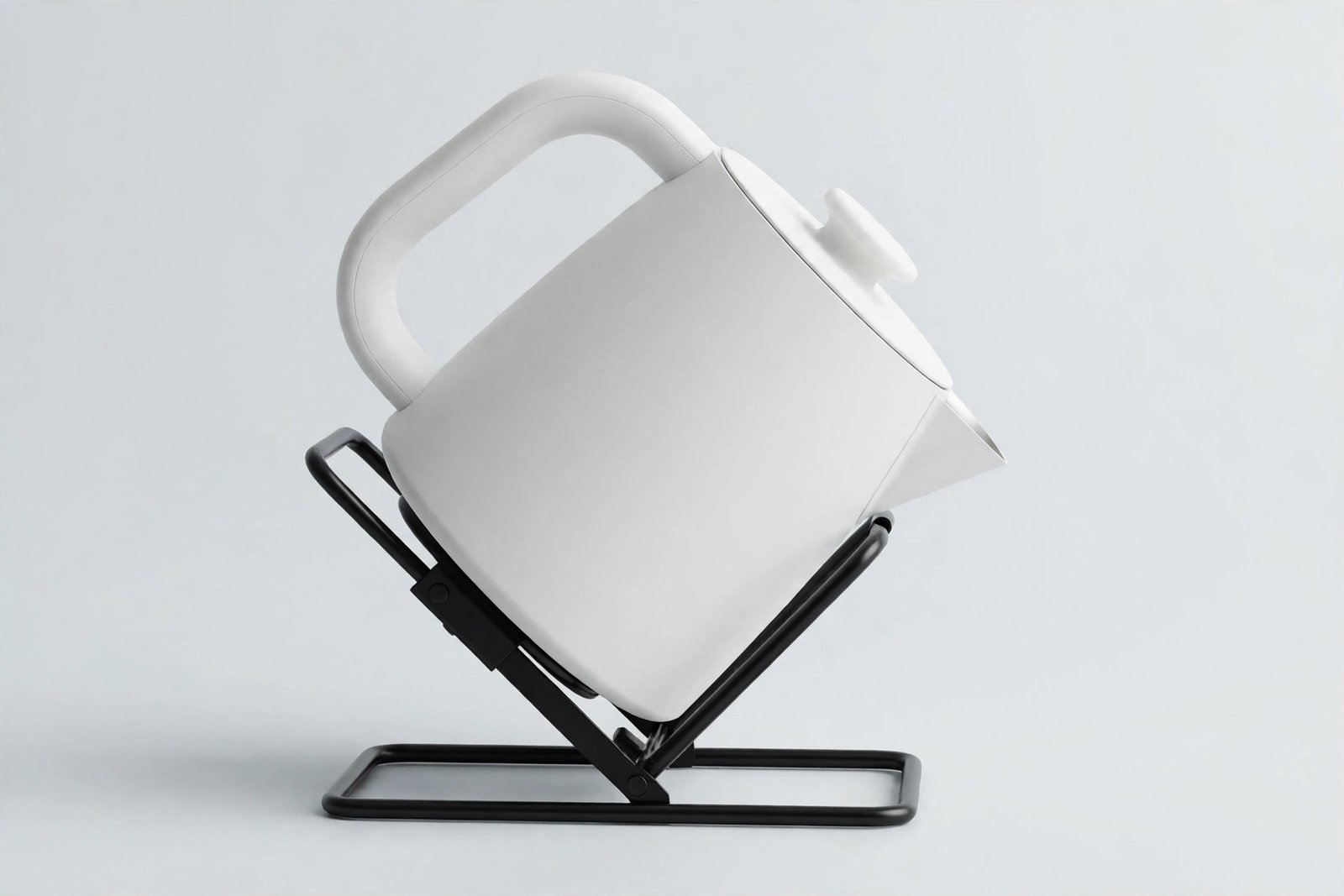
A Kettle Tipper is a cradle stand that holds your kettle and lets it pivot: instead of lifting a heavy, boiling kettle with a sore wrist, you gently tilt the cradle and the water pours. A full kettle can weigh around two kilos, and lifting-plus-tilting is one of the riskiest hand actions in the kitchen — the tipper removes the lift entirely, and with it most of the spill and scald risk that comes from a wobbling grip.
Tipper stands suit most standard jug kettles and are usually paired with a lightweight kettle, which keeps the whole setup effortless. The kettle swings back upright by itself when you let go, and many designs hold it steady while it boils, too. Tea, coffee, filling a hot water bottle, starting the pasta water — pouring happens all day, and every single pour gets safer. For many readers this is the single most valuable of all the adaptive kitchen tools, because it guards against the one accident that can do real harm.
Pros
- 👍 Pour boiling water without lifting the kettle at all.
- 👍 Greatly reduces spill and scald risk from a weak grip.
- 👍 Kettle swings back upright on its own.
- 👍 Fits most standard jug kettles.
Cons
- 👎 Takes up permanent counter space beside the socket.
- 👎 Very unusual kettle shapes may not sit securely.
- 👎 You still fill the kettle — a small lightweight jug helps.
Best for: tea and coffee drinkers with wrist weakness, tremor, or one particularly painful hand.
Check Price And User Reviews on Amazon
7. Automatic Pan Stirrer
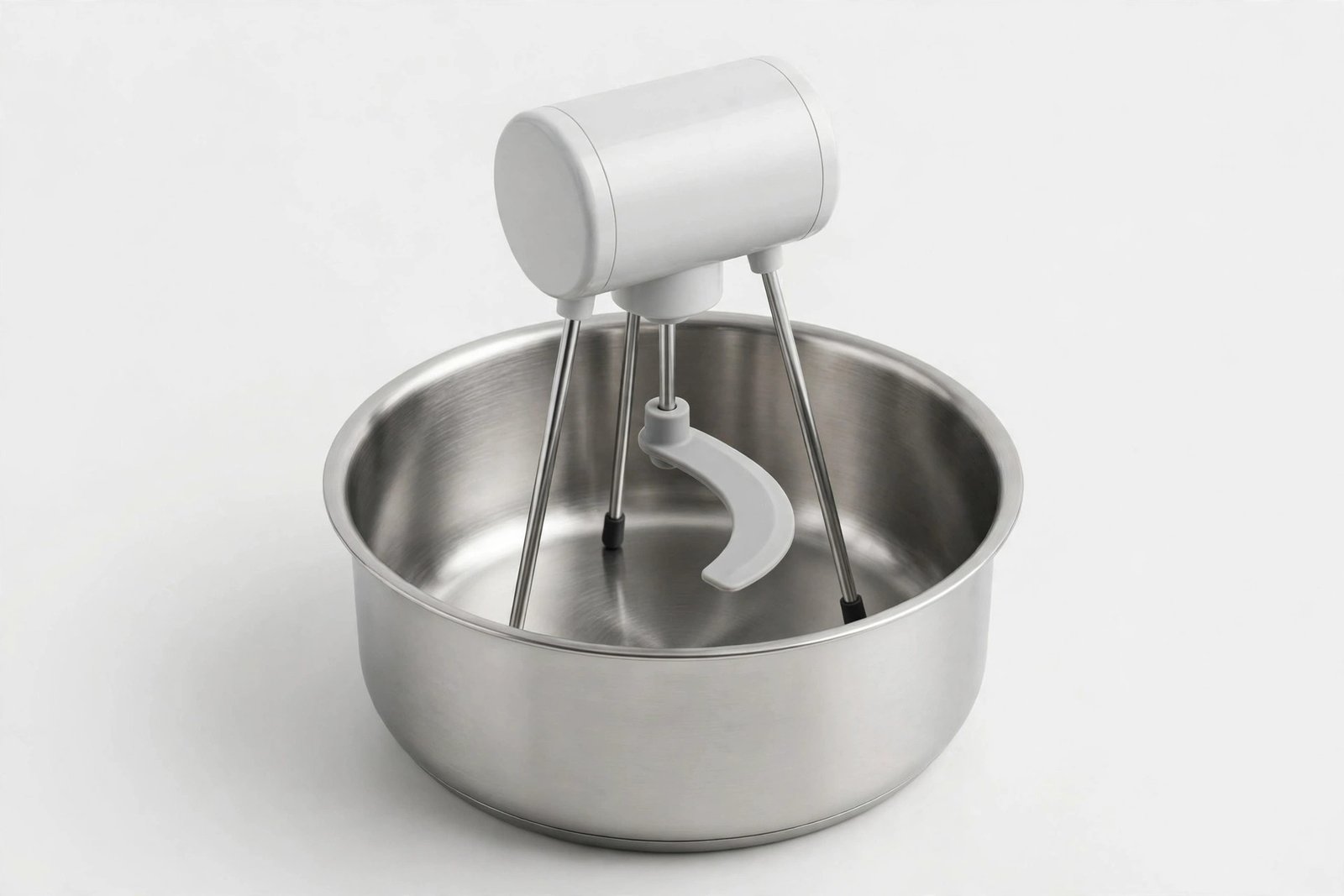
An Automatic Pan Stirrer is a small battery gadget that stands in your pan on three legs and slowly rotates, stirring the sauce, soup, porridge or custard for you. Constant stirring is a surprisingly cruel task for arthritic hands — minutes of gripping a spoon combined with endless wrist circles — and this simply takes the whole job over, in some cases for hours at a time.
It is genuinely useful rather than a gimmick: sauces thicken evenly without catching on the bottom, porridge stays smooth, and you are free to sit down instead of standing guard at the hob. Speeds adjust for thin soups versus thicker stews, and the legs unclip for the dishwasher. It will not brown onions or finish a delicate sauce, and very thick mixtures slow it down — but for the long, boring middle of cooking, it gives your hands a complete rest while dinner still gets made.
Pros
- 👍 Stirs for minutes or hours with zero hand effort.
- 👍 Stops sauces and porridge catching on the pan base.
- 👍 Adjustable speeds for thin and thick mixtures.
- 👍 Frees you to sit down while dinner cooks.
Cons
- 👎 Struggles with very thick mixtures like mash.
- 👎 Batteries need replacing or recharging.
- 👎 One more gadget to wash after cooking.
Best for: sauce, soup and porridge makers whose wrists ache after two minutes of stirring.
Check Price And User Reviews on Amazon
8. One-Handed Cutting Board

A One-Handed Cutting Board is a sturdy board fitted with stainless steel spikes in the middle and raised edges in the corners. Press a tomato, a potato, a loaf or an onion onto the spikes and it stays exactly where you put it — no second hand needed to hold it, and no chasing food around the board. The raised corners brace bread for spreading and stop items sliding off the edge.
It transforms tasks that quietly require two able hands: buttering toast, peeling a potato held on the spikes, slicing cheese, cutting up fruit. Paired with the rocker knife above, it makes a complete one-handed prep station, which is why occupational therapists recommend this style of board so often. If one of your hands is much worse than the other — severe arthritis on one side, or recovery after surgery — this is one of those kitchen gadgets for arthritic hands that gives back whole recipes, not just small comforts.
Pros
- 👍 Spikes hold food completely still for one-handed work.
- 👍 Raised corners brace bread and stop sliding.
- 👍 Helps with spreading, peeling, slicing and serving.
- 👍 Solid, washable and lasts for years.
Cons
- 👎 Spikes need care when washing and storing.
- 👎 Slightly heavier than a plain board.
- 👎 Food must be firm enough to press onto the spikes.
Best for: one-handed cooks, anyone whose weaker hand cannot hold food steady, and post-surgery recovery.
Check Price And User Reviews on Amazon
9. Electric Pepper Mill

An Electric Pepper Mill grinds fresh pepper — and most handle salt too — at the press of one large button, held loosely in one hand. A manual mill asks for exactly the movement arthritis punishes most: a hard, two-handed twist, repeated at every single meal. That is why seasoning so often quietly disappears from cooking. One light press brings the flavour back.
Most models offer an adjustable grind from fine to coarse and a clear chamber so you can see when the peppercorns run low; some add a small light over the food so you can see where the pepper lands. Refilling is the only fiddly moment, so choose a wide-mouth design. Keep one by the hob and one on the table. It sounds like a small luxury until you realise how much blander food had become purely because the manual mill hurt — of all the easy grip kitchen utensils, this is the one that gives taste back.
Pros
- 👍 Fresh-ground pepper with one light button press.
- 👍 No two-handed twisting at the table or hob.
- 👍 Adjustable grind, from fine to coarse.
- 👍 Gravity models start grinding with barely any grip at all.
Cons
- 👎 Batteries are one more thing to keep spare.
- 👎 Refilling peppercorns can be a little fiddly.
- 👎 Cheaper motors slow as the batteries fade.
Best for: anyone who stopped seasoning their food because the manual mill hurts.
Check Price And User Reviews on Amazon
10. Foam Grip Utensil Handles
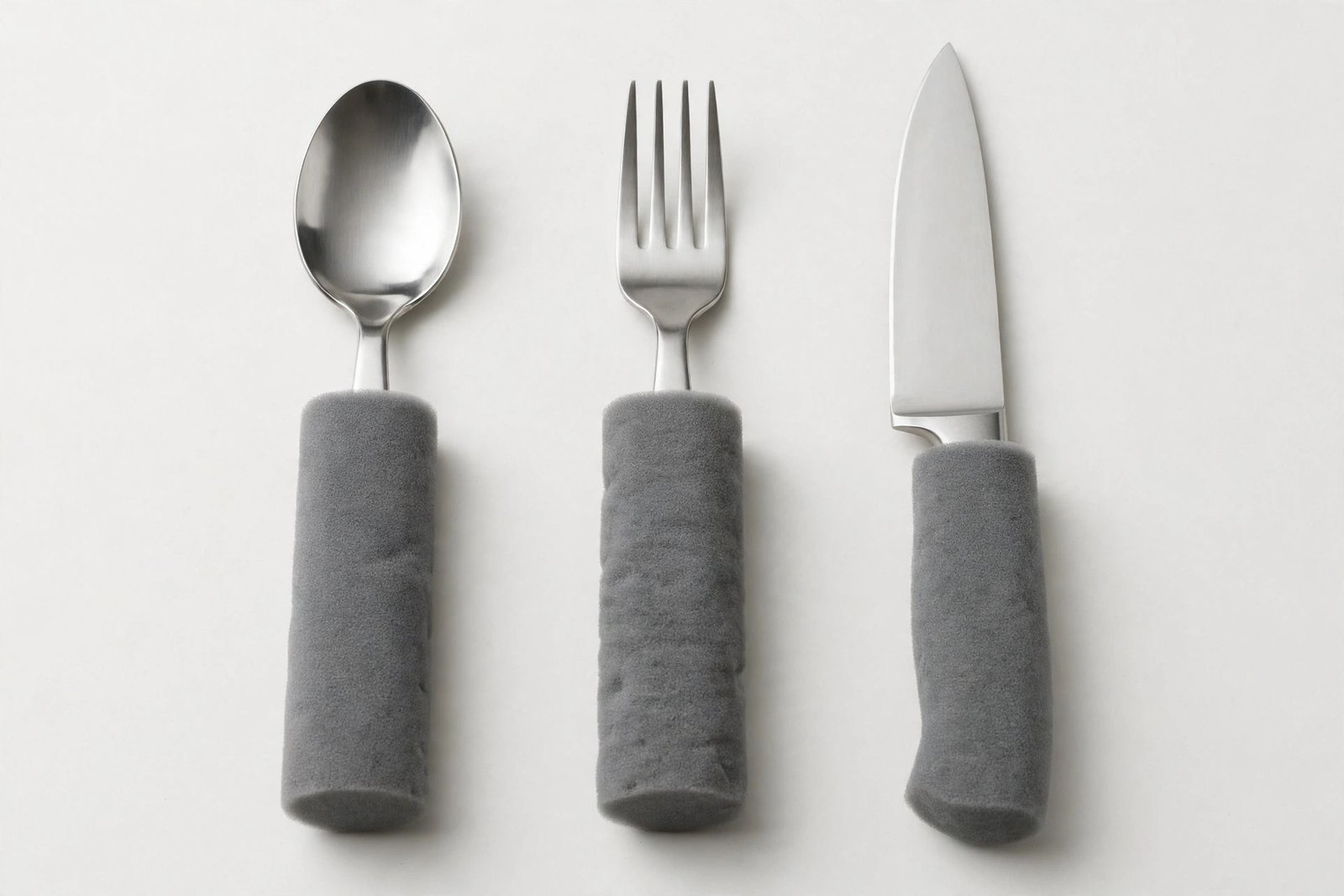
Foam Grip Utensil Handles are soft tubes of closed-cell foam that slide over the handles of the utensils you already own — spoons, forks, peelers, spatulas, even pens and toothbrushes — instantly making them thick and easy to hold. Instead of replacing a drawer of familiar tools, you adapt them for very little money, and you can fatten exactly the items you reach for most.
The tubes come in a few internal sizes and trim to length with ordinary scissors, so one pack can cover most of a kitchen drawer. Because they are just foam, they weigh almost nothing — a real advantage over some built-up cutlery for hands that tire quickly. They are also the perfect trial run: if foam grips transform your comfort at the table, you will know that a proper easy grip cutlery set is worth buying. The honest limits are that foam is a consumable — it flattens and splits eventually — and most tubes prefer a quick hand wash. As an entry point into arthritis kitchen tools, nothing gives so much relief for so little.
Pros
- 👍 Turns your existing utensils into easy grip tools.
- 👍 Very cheap and almost weightless.
- 👍 Trim to fit almost any handle in the drawer.
- 👍 A low-risk way to test whether built-up handles help.
Cons
- 👎 Foam flattens and splits over time — treat as replaceable.
- 👎 Mostly hand wash rather than dishwasher.
- 👎 Can slip on very smooth metal handles when wet.
Best for: anyone wanting to try chunky handles cheaply before buying new utensils.
Check Price And User Reviews on Amazon
11. Multi-Size Jar and Bottle Opener
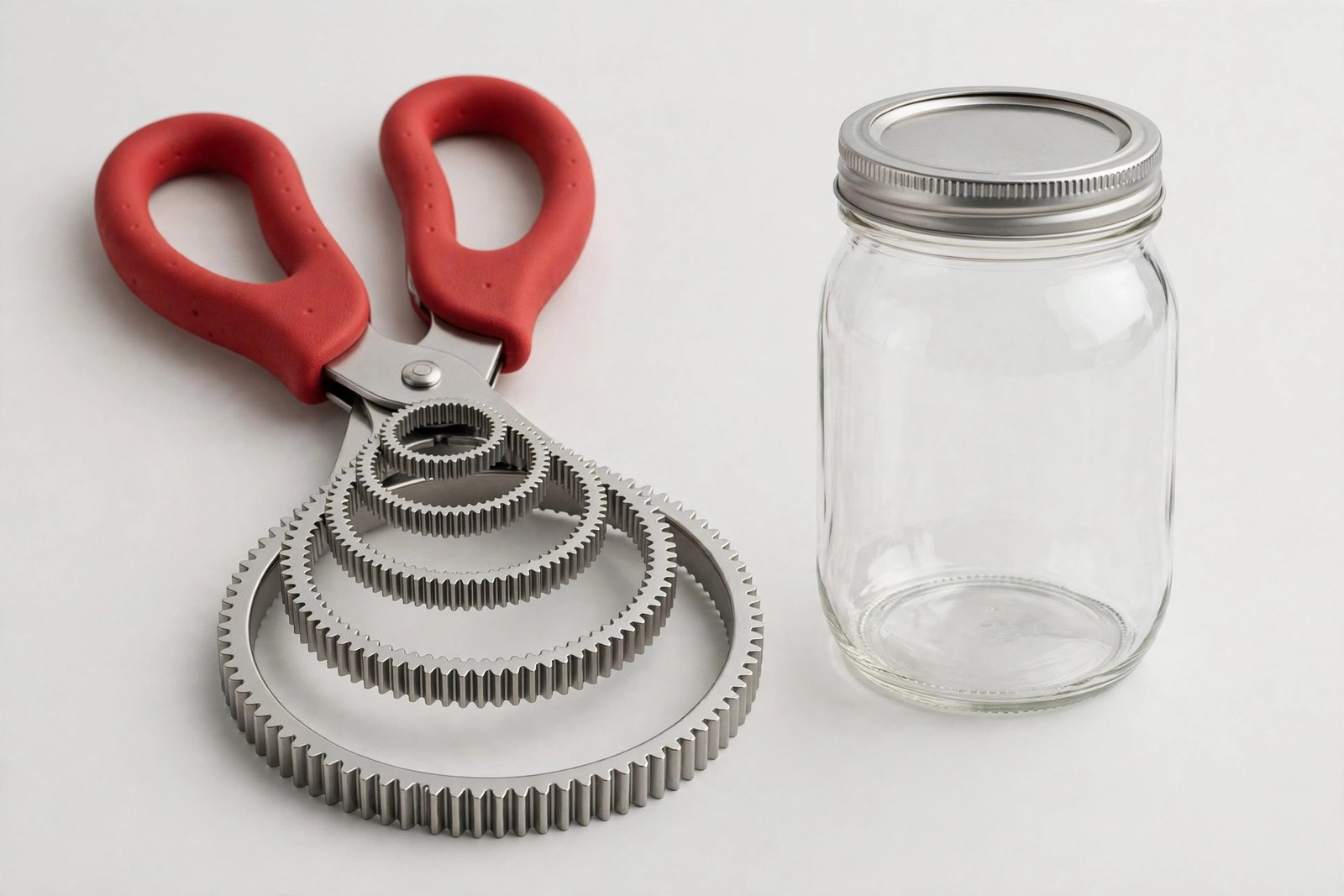
A Multi-Size Jar and Bottle Opener is a hand tool with several toothed gripping rings in different sizes and two cushioned handles you squeeze together like pliers. The ring grips the lid, the long handles multiply your force, and leverage does what grip strength no longer can. It handles everything from small drinks bottle caps up to big jam and sauce jar lids.
Unlike the electric opener above, it needs no batteries, costs little and lives in a drawer for years — but it does ask for a moderate squeeze, so it suits people whose grip is reduced rather than gone. It is also the opener that travels: holidays, caravans, a relative’s kitchen with a stubborn pickle jar. Many cooks keep both types — the electric opener for daily jars at home, this one as the never-fails backup. For sheer versatility per penny, it earns its place among the best kitchen gadgets for arthritic hands.
Pros
- 👍 Leverage multiplies a weak squeeze into real force.
- 👍 Fits caps and lids from tiny to large.
- 👍 No batteries or charging — lasts for years.
- 👍 Cheap and portable for travel and other kitchens.
Cons
- 👎 Still needs a moderate squeeze to work.
- 👎 Teeth can mark soft plastic caps.
- 👎 Very wide lids exceed the biggest ring.
Best for: people with a reduced but working grip who want one tool for every lid in the house.
Check Price And User Reviews on Amazon
12. Non-Slip Gripper Mat

A Non-Slip Gripper Mat is a simple, tacky-feeling mat that sits under bowls, chopping boards, plates and jars and stops them moving. It sounds almost too simple to count as a gadget, until you realise how many kitchen tasks are really two jobs at once — holding the bowl still AND stirring it. The mat does the holding, so your weaker hand is free, or can rest entirely.
Use it under a mixing bowl while you whisk one-handed, under the chopping board so it cannot skate across the counter, under a jar while the opener works, or under a plate that keeps travelling across the table. Smaller pieces can be cut to size and used as grip pads for lids. It rinses clean in the sink and lasts for years. It is the quiet enabler of this guide — half the other adaptive kitchen tools work noticeably better with a mat beneath them — and it asks absolutely nothing of your hands.
Pros
- 👍 Holds bowls, boards and jars completely still.
- 👍 Makes one-handed stirring and mixing possible.
- 👍 Cut to size for grip pads and liners.
- 👍 Rinses clean and lasts for years.
Cons
- 👎 Loses grip when dusty — needs regular rinsing.
- 👎 Not a heat mat; keep it away from hot pans.
- 👎 Thin versions can bunch under very heavy bowls.
Best for: every cook in this guide’s audience — the cheapest force multiplier in the kitchen.
Check Price And User Reviews on Amazon
Buying Guide
1. Match the Gadget to the Action That Hurts
The most reliable way to shop this list is to name the hand action that hurts most, then buy for that. If twisting is the enemy, start with the electric jar opener and pepper mill. If it is the pinch grip, the ergonomic peeler, foam handles and easy grip cutlery are your tools. If lifting worries you — and it should, with boiling water — the kettle tipper comes first. If holding things still is the problem, the spiked board and gripper mat change everything. And if repetitive motion sets your wrists off, the stirrer and rocker knife take over the circling and the sawing. Most people find one action causes most of their pain; fix that one first.
2. What to Check Before You Buy Any Adaptive Tool
Five checks separate the genuinely helpful arthritis kitchen tools from the disappointing ones. First, handle size and softness: the handle should fill your hand without your fingers wrapping tightly, and feel slightly cushioned, not hard plastic. Second, controls: buttons should be large and need only a light press — if a listing brags about a “firm click”, be cautious. Third, weight: pick the lightest model that does the job, because you will lift it on your worst days, not your best. Fourth, power: decide whether you will honestly keep batteries in stock, or whether rechargeable or manual-leverage designs suit your routine better. Finally, read recent reviews from buyers who mention arthritis or weak grip specifically — they report exactly the failures you are trying to avoid.
3. A Sensible First Kit
You do not need all twelve picks on day one. For most people, a starter kit of the kettle tipper, the electric jar opener and the ergonomic peeler covers the three most common daily pain points — pouring, opening and prepping — and the foam grip handles make a cheap experiment for everything else you hold. Add the cutlery set when mealtimes themselves become the struggle, and the spiked board plus gripper mat when holding food still is the barrier. Build the kit around your own cooking, one solved frustration at a time, and each purchase proves itself before the next arrives.
4. Looking After Easy Grip Tools So They Last
Adaptive tools last well with gentle care. Wash soft and foam grips by hand in warm soapy water and let them dry fully — long soaks and harsh dishwasher cycles shorten their lives. Keep batteries fresh in the electric openers and mill, because a straining motor tempts you to help it with your hands, which defeats the point. Store everything in low, easy-reach drawers rather than high cupboards; reaching up and gripping down is its own risky action. And keep the spiked board stored flat with the spikes covered or facing the back of the cupboard, so the tool that protects your hands never nicks them in storage.
Conclusion
The best easy grip kitchen gadgets for arthritis all share one philosophy: stop asking sore hands to twist, pinch, squeeze and lift, and let shape, leverage and small motors do the work instead. None of the twelve picks above is complicated, and that is the point — an electric opener, a tipping kettle, a chunkier peeler handle. Together they cover a whole day of cooking, from the first jar of the morning to seasoning dinner at the table, with the painful moments quietly removed.
If you want one safe place to start, begin with the action that hurts most: the jar opener for twisters, the kettle tipper for lifters, the peeler for pinchers. Check the latest price on Amazon before you buy, read the reviews from other buyers with arthritic hands, and enjoy how quickly the kitchen starts to feel like yours again — because with the right kitchen gadgets for arthritic hands, it is.
More Guides You’ll Like
If you are setting up a kinder kitchen, our guide to gadgets for elderly parents covers more comfort-first picks for the whole home, and our roundup of kitchen gadgets for meal prep pairs naturally with the stirrer and spiked board above. Working to a budget, see our kitchen gadgets under $50 and the small problem-solvers in our guide to useful gadgets under $25 for everyday use. For a more connected kitchen, our smart kitchen gadgets under $100 cover app-controlled helpers, and if your kitchen is small as well as sore on the hands, our kitchen gadgets for small apartments keeps every pick compact.
FAQs
What makes a kitchen gadget arthritis friendly?
Four things: a wide, soft handle that spreads pressure across the whole hand instead of concentrating it in the fingers; controls that need only a light press rather than a twist or squeeze; a light weight, so the tool is manageable on a bad day; and a design that works one-handed or hands-free where possible. Any tool that removes twisting, pinching and lifting qualifies as one of the better arthritis kitchen tools, whatever its label says.
Are electric jar and can openers really easier than manual ones?
Yes — they remove the two hardest actions entirely. A manual opener asks you to squeeze handles and twist a knob or grip a lid hard enough to resist the turning force; an electric model asks you to place it and press one button. The only habits to keep are fresh batteries or regular charging, and a wipe of the gripping parts so they bite properly. For most people with arthritic hands, the difference is not subtle — jars stop being a two-person job.
Do these tools help with a weak grip even without arthritis?
Yes. Almost everything in this guide was designed around reduced grip strength and sore joints generally, so the same picks help with carpal tunnel symptoms, tendonitis, post-surgery or post-stroke recovery, and the general grip loss that can come with age. Occupational therapists recommend the same categories — built-up handles, leverage openers, stabilising boards and mats — for all of these situations, because the problem they solve is the same: hands that should not have to force things.
Which easy grip gadget should I buy first?
Buy for your most frequent painful moment. For most people that is one of three: the electric jar opener if lids defeat you daily, the kettle tipper if pouring hot water has started to feel risky, or the ergonomic peeler if you cook vegetables every day. The foam grip handles are the best first experiment of all, because for very little money they tell you within one meal whether built-up handles are the answer for your hands.
Can easy grip cutlery and foam handles go in the dishwasher?
It depends on the material. Stainless cutlery with solid moulded handles is usually dishwasher safe, though hand washing keeps the finish nicer for longer. Foam grip tubes are the exception — most should be hand washed in warm soapy water and air dried, because dishwasher heat and detergents break the foam down faster. As a rule, if a grip feels soft and spongy, treat it gently; if it feels like firm moulded plastic or silicone, the dishwasher is normally fine. The listing for each product states which.
How wide should a handle be for arthritic hands?
As a rough guide, look for handles around the thickness of a thick marker pen or a bit more — wide enough that your fingers close around it loosely rather than wrapping tightly, with a slightly soft, non-slip surface. If your fingers can touch your palm when you grip a tool, the handle is too thin. Foam tubes are useful here because you can layer or swap sizes until the grip feels right, and many people keep two thicknesses: slimmer for good days, chunkier for flare-up days.



One Comment