Best Kid Safe Kitchen Gadgets for Cooking With Toddlers: 12 Supervised Picks for Little Helpers
As an Amazon Associate, we earn from qualifying purchases made through links on this page, at no extra cost to you. This helps support our work and keeps our guides free to read.
A quick note on prices: prices change often, so we never quote a fixed price here. Please check the latest price on Amazon before you buy, using the yellow buttons in this guide. The product pictures in this article are original illustrations created for this guide, not manufacturer photos.
Introduction
If you are looking for the best kid safe kitchen gadgets for cooking with toddlers, you probably have a small person who insists on helping — standing on tiptoe at the counter, reaching for whatever you are holding, and announcing “my turn” at every stir, pour and sprinkle. Cooking together builds language, counting, patience and a child who actually eats what they helped make. But the ordinary kitchen is built for adults: sharp metal knives, heavy bowls, hot pans and tools sized for big hands. The right toddler cooking tools bridge that gap: real jobs, sized for small hands, in forgiving materials.
One thing must be said plainly at the start, because everything in this guide depends on it: “kid safe” never means unsupervised. Every pick is for cooking with your toddler, side by side, watched and guided the whole time. Toddlers should never use sharp metal knives, and they should never be near heat, ovens, hobs or boiling water — those jobs stay with the adult, always, however confident the child seems. These gadgets do not make the kitchen safe on their own; they make the safe parts of cooking — washing, stirring, pouring, mashing, rolling, sprinkling and cutting soft foods with blunt tools — accessible to a small child standing right beside you.
We have spread the twelve picks across the jobs toddlers can actually do. There are blunt cutting tools for soft foods, so your child can “chop” a banana while you handle anything firm. There are toddler kitchen helper tools that fix the practical problems: a stool for safe counter height, a bowl that cannot slide away mid-stir, utensils sized for small hands. And there are the fun finishes — an apron, dough tools, muffin cups to fill — because half the point of cooking with toddlers safely is that it feels like play while teaching them how food happens.
Every pick is a product type used in Montessori-style kitchens and family homes alike, and each is honest about its limits: nylon knives still need soft food, step stools still need an adult within arm’s reach, and nothing here turns a toddler into a sous chef overnight. Start with one or two tools, keep the rules consistent, and these kid friendly kitchen gadgets will earn their drawer space every week.
How We Chose
We chose these twelve products by asking one question of each candidate: can a toddler use this to do a real kitchen job, at the counter, beside an adult, without the tool itself introducing a sharp edge, a burn risk or a tipping hazard? A gadget earned its place if its safety comes from the design — blunt nylon instead of steel, enclosed blades instead of open ones, suction bases instead of slide-prone bowls, rails and non-slip steps instead of a wobbly chair. Anything that was simply a small version of an adult tool, sharp bits included, was left out, as was anything electrical or heat-related — safe cooking activities for toddlers happen at room temperature.
We also favoured tools that respect how toddlers behave. They push too hard, let go mid-task, and lose interest in ninety seconds, so we looked for chunky grips, forgiving materials, and jobs with an instant visible result — a banana that slices, dough that flattens, batter that swirls. Easy cleaning mattered too, because a gadget that survives the dishwasher survives family life. Finally, we spread the picks across the whole session — arriving, prepping, mixing, shaping and serving — so the list works as a complete toolkit rather than twelve versions of the same idea.
Quick List
- Toddler Nylon Knife Set — blunt serrated nylon knives that slice soft foods, not skin.
- Crinkle Cutter — a push-down wavy cutter that makes fun ridged slices of soft fruit and veg.
- Toddler Step Stool with Safety Rails — brings your helper to counter height with rails and non-slip steps.
- Toddler Apron and Chef Hat Set — their own kit that keeps clothes cleaner and makes helping feel official.
- Suction Base Mixing Bowl — a bowl that stays stuck to the counter through enthusiastic stirring.
- Kids Whisk and Utensil Set — short-handled tools sized for small hands and real control.
- Silicone Muffin Cups — unbreakable, easy-release cups little hands can fill, carry and peel.
- Kids Rolling Pin and Dough Tools Set — rolling, pressing and cutting dough shapes with no sharp edges.
- Banana Slicer — press-down slicing that turns a banana into even rounds in one go.
- Hand Food Chopper with Enclosed Blade — parent-led chopping with the blade fully enclosed, for little hands to help pull or press.
- Silicone Placemat with Sections — a stay-put mat that organises ingredients into toddler-sized workstations.
- Potato Masher — two-handed mashing power for soft potatoes, eggs and avocado.
1. Toddler Nylon Knife Set

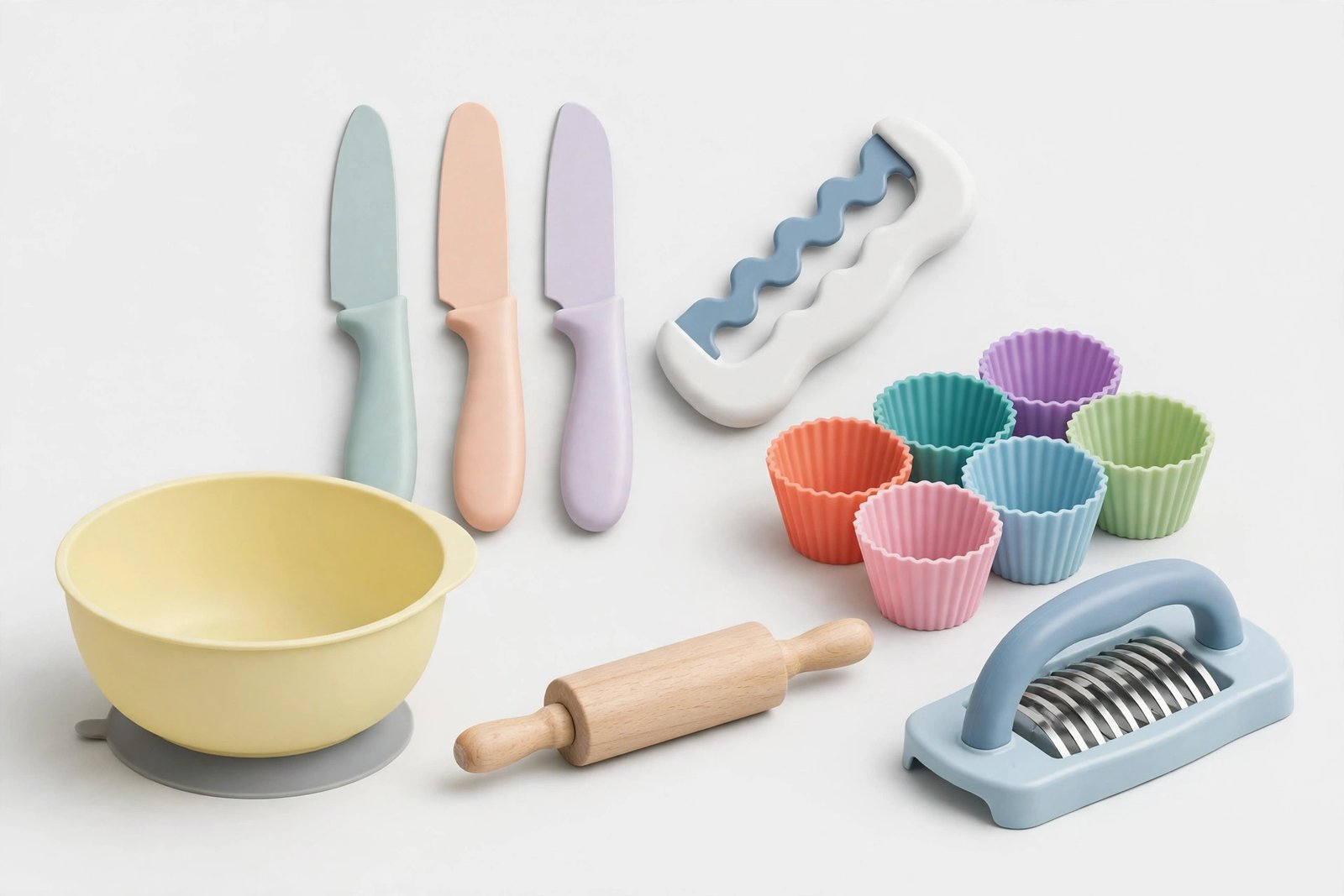
A Toddler Nylon Knife Set is the tool that turns “watch me” into “my turn”. These knives are moulded from nylon or sturdy plastic with a serrated edge that grips and saws through soft foods — bananas, strawberries, ripe avocado, soft cheese, sandwiches — while sliding harmlessly over skin. The tips are rounded, the handles chunky for a whole-hand grip, and most sets include two or three sizes. Cutting is the job toddlers most want to copy, and this is how they do it for real.
Keep the boundaries as clear as the tool is blunt. Soft foods only: the moment a food needs force — a raw carrot, an apple — it becomes an adult job with an adult knife. Set the toddler up with pre-softened ingredients on a stable board, stand beside them, and let them saw at their own pace; the serrations mean success comes quickly, which keeps a two year old engaged. Most sets are dishwasher safe, with no sharp edges to worry about in the drawer.
Pros
- 👍 Blunt serrated edge cuts soft food, not skin.
- 👍 Chunky handles suit a whole-hand toddler grip.
- 👍 Lets toddlers do the job they most want to copy.
- 👍 Lightweight, washable and safe in the drawer.
Cons
- 👎 Only works on soft foods — firm veg stays an adult job.
- 👎 Still needs constant adult supervision, like every tool here.
- 👎 Determined toddlers can chew the handles.
Best for: first cutting practice on bananas, strawberries and other soft foods, beside an adult.
Check Price And User Reviews on Amazon
2. Crinkle Cutter

A Crinkle Cutter works completely differently from a knife: instead of sawing, your toddler grips the wide handle with both hands and pushes straight down, and the wavy edge slices soft foods into ridged, crinkle-cut pieces. That push-down action is far easier to control than a back-and-forth saw, and the results are delightful — wavy cucumber coins, ridged melon sticks and crinkle-cut cheese. Ridged pieces are easier for little fingers to pick up, a quiet win at snack time too.
Choose a cutter with a broad handle and a guard between the hand and the wavy edge, and use it on a stable, non-slip board. The same soft-food rule applies as with the nylon knives: bananas, melon, steamed vegetables and soft cheese are toddler territory; anything firm is pre-cut by the adult. Because the motion is two-handed and downward, many parents find this the first “cutting” tool a toddler manages — and it works in either hand, a kindness we explore in our guide to kitchen gadgets for left handed cooks.
Pros
- 👍 Simple push-down motion toddlers can control.
- 👍 Wavy slices are fun and easier to grip.
- 👍 Works in either hand, with both hands on the handle.
- 👍 Makes snack prep feel like a proper achievement.
Cons
- 👎 Soft foods only, like all toddler cutting tools.
- 👎 The wavy edge needs careful washing between the ridges.
- 👎 Very small pieces can stick in the waves.
Best for: younger toddlers making their first cuts, and crinkle-cut fruit and veg snacks.
Check Price And User Reviews on Amazon
3. Toddler Step Stool with Safety Rails

A Toddler Step Stool with Safety Rails is the foundation that every other pick in this guide stands on — literally. Toddlers cannot help at a counter they cannot reach, and the usual improvisations — a dining chair, an upturned crate — are exactly how accidents happen. A purpose-built stool or learning tower gives them a stable platform at counter height, with safety rails to hold, non-slip steps, and a wide base that does not tip when a small person shifts weight.
Position is everything. Place the stool on a flat floor, away from the hob and oven — the adult works at the heat, the child at a clear stretch of counter — and keep yourself within arm’s reach; rails reduce risk, they do not replace supervision. Look for a weight rating that leaves growing room and a finish that wipes clean after flour day. In bigger households the stool becomes shared infrastructure, as the helpers in our roundup of kitchen gadgets for large families with kids demonstrate. It is the least glamorous and most important purchase on this list.
Pros
- 👍 Stable counter-height access with rails to hold.
- 👍 Non-slip steps make climbing up and down safer.
- 👍 Wide base resists tipping when toddlers wriggle.
- 👍 Doubles for handwashing and other daily routines.
Cons
- 👎 Takes real floor space in a small kitchen.
- 👎 An adult must stay within arm’s reach regardless.
- 👎 Taller towers can be heavy to move and store.
Best for: every toddler cook — the safe starting point for all counter work.
Check Price And User Reviews on Amazon
4. Toddler Apron and Chef Hat Set

A Toddler Apron and Chef Hat Set does two jobs at once: a washable apron takes the flour, berry juice and yoghurt that would otherwise end up on clothes, session after session, and putting on “chef clothes” marks the start of kitchen time — with its rules — the way a uniform does. Many parents find the ritual useful for safety: apron on means we stay at our station, wash hands first, and only touch what the grown-up gives us. Apron off, kitchen time is over.
Choose a set with an adjustable neck strap and simple fastenings you can do up quickly, in a fabric that goes straight in the washing machine. Avoid long dangling ties, and keep aprons well away from the hob area regardless — loose fabric and heat never mix, another reason the toddler’s workstation belongs at a clear counter. The hat is pure theatre and worth it. Among all the toddler cooking tools in this guide, this is the one that makes a child feel the part before they have lifted a spoon.
Pros
- 👍 Protects clothes through flour, juice and batter.
- 👍 The dressing-up ritual reinforces kitchen rules.
- 👍 Machine washable and quick to put on.
- 👍 Makes toddlers feel like real chefs.
Cons
- 👎 Long ties can dangle — choose tidy fastenings.
- 👎 Some toddlers refuse the hat within minutes.
- 👎 Pure protection and theatre — it teaches no skill itself.
Best for: starting a kitchen routine, messy baking days, and very proud little chefs.
Check Price And User Reviews on Amazon
5. Suction Base Mixing Bowl

A Suction Base Mixing Bowl solves the first law of toddler stirring: whatever can slide, will slide — usually off the counter, batter and all. The suction cup under this bowl locks it to a smooth counter, so when your toddler stirs with their whole arm (and they will), the bowl stays put and only the mixture moves. That turns stirring from a two-person rescue operation into a job a small child can genuinely own: oats and milk, yoghurt and berries, muffin batter and salads.
Look for a bowl with a pouring spout and a handle you can steady while the child stirs — the same stay-put logic that makes these bowls a favourite in our guide to one handed kitchen gadgets for new parents, where the spare hand is holding a baby. Suction works best on smooth, clean, dampened surfaces, so test the grip before the batter goes in. A mid-size bowl suits toddler portions and small arms. When the session ends, the whole thing goes in the dishwasher.
Pros
- 👍 Bowl stays stuck fast through enthusiastic stirring.
- 👍 Frees the adult from holding the bowl all session.
- 👍 Spout and handle make supervised pouring easier.
- 👍 Ends the classic batter-across-the-floor moment.
Cons
- 👎 Suction needs a smooth, clean surface to grip.
- 👎 A determined toddler can still lift and tip it.
- 👎 The suction ring needs washing underneath.
Best for: stirring and mixing jobs — the heart of toddler baking.
Check Price And User Reviews on Amazon
6. Kids Whisk and Utensil Set
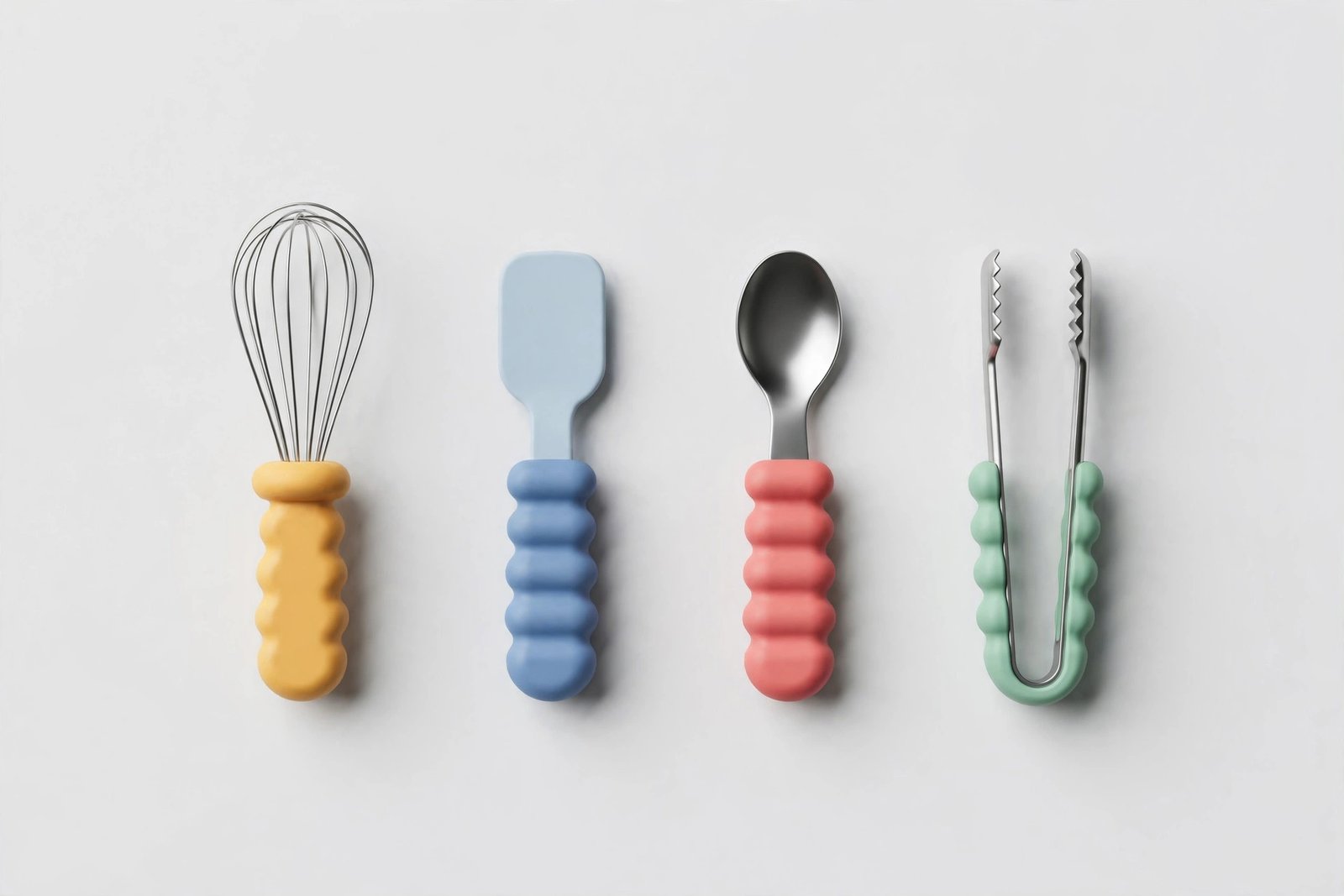
A Kids Whisk and Utensil Set fixes the mismatch nobody notices until a toddler stirs with a full-size whisk: the handle is longer than their forearm and half the mixture ends up on the counter. Child-size tools — a short balloon whisk, mini spatula, small spoon, tongs and a pastry brush — are proportioned for small hands and short arms, so the movements work. Stirring, scooping, spreading, brushing oil or milk onto dough (which the adult then bakes), and serving all become doable jobs.
Silicone heads are the practical choice: soft against bowls, quiet when dropped, and safe if they end up being chewed, as everything does. Keep the set together in its own pot or drawer section so “your tools” are part of the routine. And keep the one rule that matters: utensils stir cold mixtures and serve finished food — anything involving a hot pan belongs to the adult’s hands, with the toddler watching from their stool. That is the difference between a child waving an adult’s whisk around and a child actually cooking.
Pros
- 👍 Sized for small hands and short arms.
- 👍 Covers stirring, spreading, scooping and serving.
- 👍 Silicone heads are soft, quiet and easy to clean.
- 👍 Their “own tools” build ownership and routine.
Cons
- 👎 Small pieces wander — expect a few losses.
- 👎 Mini whisks cannot handle thick adult batters.
- 👎 Tongs need practice before they grip reliably.
Best for: everyday stirring, spreading and serving jobs at the counter.
Check Price And User Reviews on Amazon
7. Silicone Muffin Cups
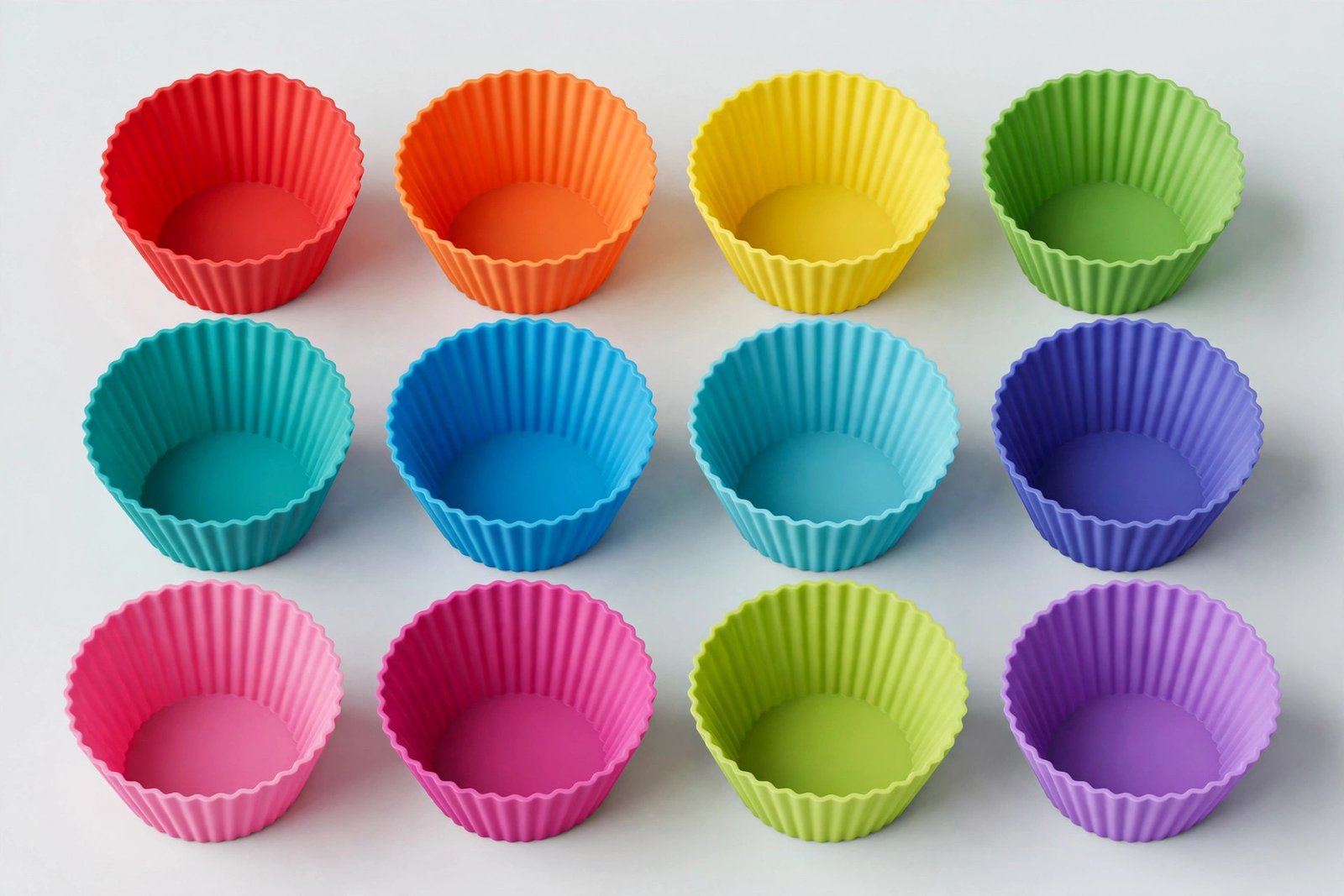
Silicone Muffin Cups turn the fiddliest part of muffins — paper liners that stick, tear and collapse — into a job a small child can do start to finish. The cups are unbreakable, bendy and brightly coloured; your toddler can carry them, arrange them on the tray, spoon in batter (with gloriously imperfect aim), and later peel the flexible cup away from the finished muffin. Nothing shatters if dropped, and the colours make “which one is mine?” a game instead of an argument.
Be clear about roles: filling cups is toddler work at the counter; the tray going into and out of the oven is adult work, full stop, and finished muffins cool completely before little hands peel them. Beyond muffins, the cups moonlight as snack pots, sorting cups for sprinkles and berries, and moulds for frozen yoghurt bites. They are close to indestructible in the dishwasher — our guide to easy clean kitchen gadgets for busy weeknights sings silicone’s praises for grown-up cooking too.
Pros
- 👍 Unbreakable and safe for little hands to handle.
- 👍 Easy release — toddlers can peel their own muffins.
- 👍 Double as snack pots, sorting cups and moulds.
- 👍 Dishwasher safe and nearly indestructible.
Cons
- 👎 Floppy when full — carry them on a tray.
- 👎 Still need light greasing for some batters.
- 👎 Oven handling stays strictly an adult job.
Best for: muffin and cupcake days, plus snack sorting and frozen treats.
Check Price And User Reviews on Amazon
8. Kids Rolling Pin and Dough Tools Set

A Kids Rolling Pin and Dough Tools Set opens up the most toddler-friendly category in all of cooking: dough. A short rolling pin sized for two small hands, blunt shape cutters, a soft dough scraper and a pastry brush give your child a complete workstation — roll it flat, press out a star, scrape it up, roll it again. Dough is forgiving, room-temperature and endlessly reusable within the session: pizza bases, flatbreads, biscuits and pastry offcuts can absorb an hour of effort, and the adult bakes the results later.
Flour management is the honest challenge: give the toddler a small pot of flour for dusting rather than the open bag, work on a tray that contains the spread, and accept some flour on the floor as the price of admission. Choose smooth, washable tools with no detachable small parts, and check wooden pins for splinters as they age. Because dough work involves no cutting force and no heat at the child’s station, it is one of the safest activities in this guide — and the pride when “their” pizza comes out of the oven (carried by you) is unmatched.
Pros
- 👍 Dough is forgiving, safe and endlessly reworkable.
- 👍 Short pin suits two-handed toddler rolling.
- 👍 Cutters make shapes with zero sharp edges.
- 👍 Builds real skills for pizza and biscuit days.
Cons
- 👎 Flour gets everywhere — contain it on a tray.
- 👎 Wooden tools need checking for wear and splinters.
- 👎 Baking the results is, as always, adult-only.
Best for: pizza nights, biscuit making and long, happy dough sessions.
Check Price And User Reviews on Amazon
9. Banana Slicer

A Banana Slicer might be the most satisfying tool in this entire guide, from a toddler’s point of view. The adult peels the banana and lays it on the board; the toddler positions the frame over it and presses down with both hands, and the whole banana becomes a row of even slices in a single go. There is no sawing and no aiming — just one press and a result that feels like a magic trick. For children not yet ready for even a nylon knife, this is often their first true “I cut it myself” moment.
The slicing wires or plastic grid are enclosed within the frame, and the tool only works on banana-soft foods, which keeps it in toddler territory — some families also use it for ripe avocado. It is a one-fruit wonder, admittedly, and needs a rinse straight after use. But breakfast in many homes involves a banana most days, which makes this little press one of the hardest-working kid friendly kitchen gadgets you can own. Pair it with the nylon knife set and your toddler has a complete soft-food cutting station, graduated by difficulty.
Pros
- 👍 One press makes a whole row of even slices.
- 👍 No sawing or aiming — ideal first cutting tool.
- 👍 Slicing grid sits enclosed inside the frame.
- 👍 Breakfast bananas become the toddler’s job.
Cons
- 👎 Essentially a one-fruit tool.
- 👎 Needs rinsing immediately or banana dries on.
- 👎 Does not fit very curved or oversized bananas.
Best for: the youngest helpers, and daily banana slicing at breakfast.
Check Price And User Reviews on Amazon
10. Hand Food Chopper with Enclosed Blade

A Hand Food Chopper with Enclosed Blade comes with a bright line around it: parent-led, never a toddler’s own tool. The adult loads the container, locks the lid, and does the handling; the toddler’s part is the fun, safe bit at the end — pulling the cord or pressing the plunger with both hands while the blade spins inside the sealed container, chopping herbs, onion, nuts or cooked vegetables for the family meal. Done this way, a small child contributes to real prep, and the blade is never reachable while it moves.
The rules are non-negotiable: the adult opens, empties and washes the chopper, because the enclosed blade is a real blade the moment the lid comes off; the container lives out of toddler reach between uses, like the adult knives. Choose a model whose lid locks positively and cannot be opened mid-chop. This graduated approach — the child powering a tool the adult controls — is the same philosophy behind good kitchen gadgets for meal prep: everyone does the part that matches their ability.
Pros
- 👍 Blade stays fully enclosed while it spins.
- 👍 Toddlers can power the pull or press themselves.
- 👍 Speeds up real family prep, not just play cooking.
- 👍 No electricity, no cords, no hot parts.
Cons
- 👎 Parent-led only — loading and washing are adult jobs.
- 👎 The blade is sharp once opened; store out of reach.
- 👎 Pull cords need an adult hand steadying the base.
Best for: family prep sessions where the toddler powers and the adult handles.
Check Price And User Reviews on Amazon
11. Silicone Placemat with Sections

A Silicone Placemat with Sections quietly organises the whole toddler cooking session. The grippy silicone stays put on the counter or table, the sections and measured markings divide the workspace into “mine” and “not mine”, and the contained surface catches spills, sprinkles and flour before they spread. Set out the mat and the station is defined: board here, ingredients in these sections, finished pieces over there. For a small child, that visible structure is the difference between helping and wandering.
The measured sections earn their keep in real cooking, too — a toddler can fill a section with berries, count out spoonfuls into the marked cups, or line up banana slices for the banana bread, all early maths disguised as cooking. At the table the mat becomes a non-slip placemat under their plate, and at clean-up it lifts, folds and goes under the tap or into the dishwasher, mess contained. It is less a tool than the ground rules made visible — and that quiet organisation is what makes cooking with toddlers safely feel calm rather than chaotic.
Pros
- 👍 Defines the toddler’s workstation at a glance.
- 👍 Grippy surface stays put and catches spills.
- 👍 Measured sections sneak counting into cooking.
- 👍 Wipes, rinses or dishwashes clean in seconds.
Cons
- 👎 Large mats need storage space when not in use.
- 👎 Sections are guides, not real measuring tools.
- 👎 Silicone can hold onto strong food smells at first.
Best for: setting up a toddler station, baking days and tidy snack prep.
Check Price And User Reviews on Amazon
12. Potato Masher
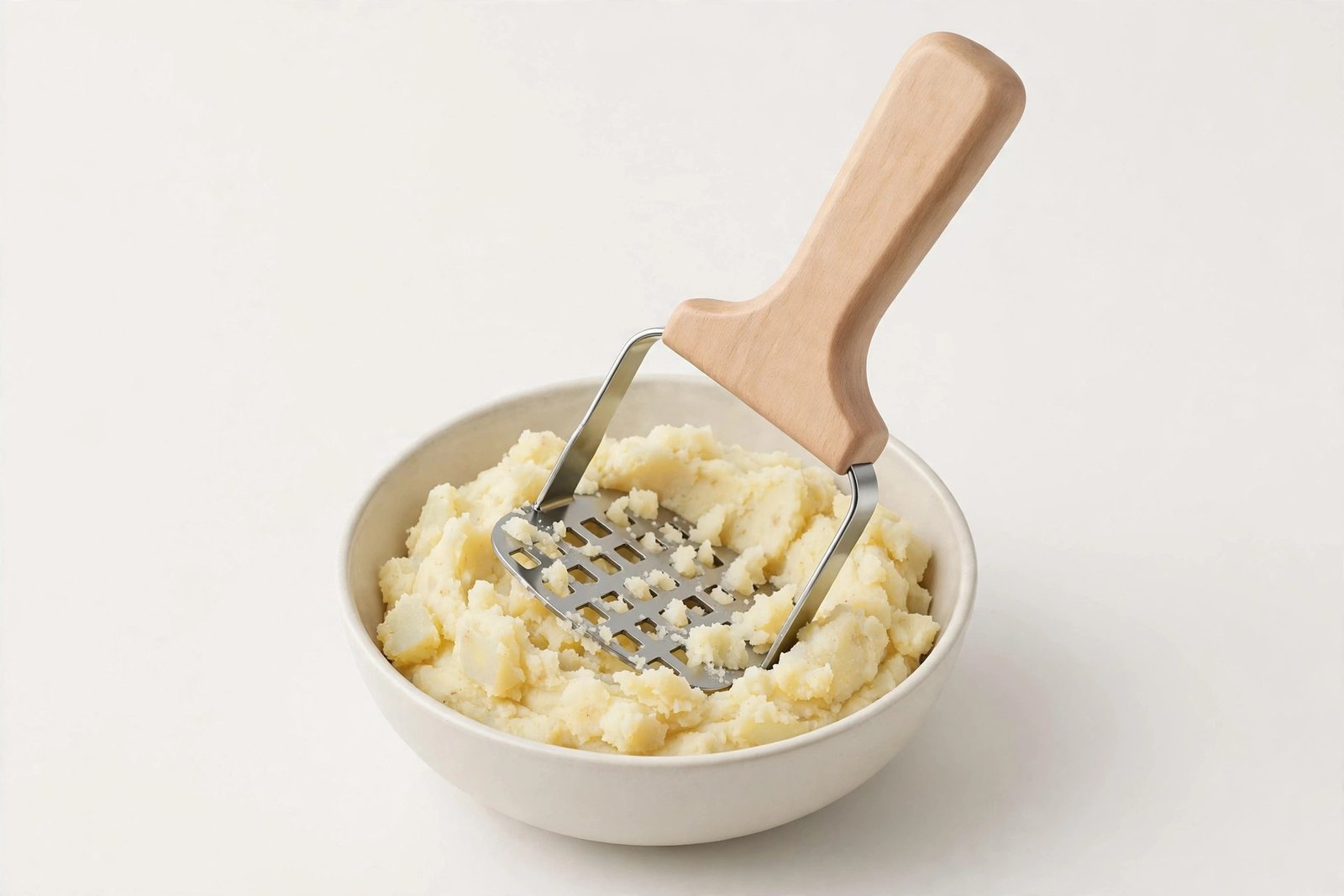
A Potato Masher is the power tool of the toddler kitchen — the one gadget that rewards maximum effort with maximum visible change. Gripped with both hands and pushed straight down, it turns soft cooked potato, sweet potato, avocado, banana, boiled egg and steamed pumpkin into mash, and toddlers throw their whole body into it with satisfaction. There are no edges, no moving parts and nothing to plug in; the only skill is aim, and a deep bowl — ideally the suction-based one from earlier in this list — keeps the target in place.
One safety point defines this tool’s use: the food must be fully cooked and cooled to warm, never hot, before the bowl comes to the toddler’s station — the adult cooks, drains and cools; the toddler mashes. Choose a masher with a broad handle and a grid or zigzag head, in stainless steel or strong nylon that survives the dishwasher. Mashing also builds the hand and arm strength that later makes real utensils easier, which is why this simplest of tools closes our list: it is often the first job a toddler does entirely on their own — with you right there, as always.
Pros
- 👍 Two-handed mashing toddlers find deeply satisfying.
- 👍 No edges, parts or power — as simple as tools get.
- 👍 Works for potato, avocado, egg, banana and more.
- 👍 Builds the grip and arm strength cooking needs.
Cons
- 👎 Food must be cooked and cooled by the adult first.
- 👎 Enthusiastic mashing escapes shallow bowls.
- 👎 Very smooth purées are beyond a masher’s reach.
Best for: mash, guacamole, egg salad and other squash-it-flat jobs.
Check Price And User Reviews on Amazon
Buying Guide
1. The Supervision Rules Come First, Always
Before choosing any gadget, fix the rules that no gadget replaces. A toddler in the kitchen is supervised directly — an adult at the same counter, within arm’s reach, every minute. Sharp metal knives are adult-only, without exception or “just this once”; the blunt tools in this guide exist so the rule never needs bending. Heat is adult-only too: hobs, ovens, kettles and pans of hot food stay in the adult’s zone, and the toddler’s station sits on a clear stretch of counter away from all of it. Finally, everything a toddler uses gets washed before and after, and small or damaged parts retire immediately. Kid safe describes the tools; supervision is what makes the activity safe.
2. Match the Tool to Your Toddler’s Stage
Toddlers change fast, and the right first tool depends on where yours is. For the youngest helpers — roughly eighteen months to two and a half — start with tools that need only whole-hand power and give instant results: the banana slicer, the potato masher, the suction bowl, and dough tools. From around two and a half, add the crinkle cutter and the nylon knife set for soft foods, with the adult prepping anything firm. Older toddlers can graduate to powering the enclosed hand chopper (parent-led) and running a full workstation on a sectioned placemat. If a tool frustrates your child twice, shelve it for a month rather than pushing — these gadgets should make cooking feel like success.
3. What to Check Before You Buy Toddler Kitchen Tools
Four checks separate genuinely kid friendly kitchen gadgets from small adult tools in bright colours. First, edges and points: run a fingertip along every working surface, or read reviews closely — you want blunt, rounded and enclosed, everywhere. Second, materials: food-grade silicone, nylon and smooth wood; check finishes are food safe and nothing small can detach. Third, stability: suction bases that grip, handles a whole fist can hold, and stools with wide bases and honest weight ratings. Finally, cleaning: if it cannot go in the dishwasher or under the tap in seconds, it will quietly leave your routine. Reviews from parents of toddlers test exactly the failure modes you care about.
4. Setting Up a Toddler Station That Works
The setup matters as much as the shopping. Choose one regular spot — the same clear counter section each time — with the step stool placed there and the hob out of the child’s zone. Lay the sectioned placemat to mark the station, put only the session’s tools and ingredients within reach, and keep adult tools, hot items and anything sharp behind you or in another area. Keep sessions short and finish while it is still fun; fifteen happy minutes beats an hour that ends in tears. Wash hands together at the start, apron on, and keep a simple job list in your head — wash, stir, mash, pour, sprinkle — so there is always a next task. Cooking with toddlers safely is a routine, and routines are what toddlers trust.
Conclusion
The best kid safe kitchen gadgets for cooking with toddlers share one philosophy: real jobs, blunt tools, and an adult right there. The nylon knives and crinkle cutter hand over the cutting of soft foods; the stool, suction bowl and sectioned mat make the workstation stable and calm; the utensils, dough tools, muffin cups and masher cover stirring, shaping and squashing; and the enclosed chopper shows how a toddler can graduate to powering real prep while the adult keeps hold of everything sharp. None of it works unsupervised — and with supervision, all of it works beautifully.
If you buy one thing, make it the step stool, because safe access to the counter is where every session starts; add the nylon knife set or banana slicer for the first proud “I cut it” moment. Whatever you choose, check the latest price on Amazon before you buy, set up the station with heat and sharp tools in the adult zone, and enjoy the chaos of cooking with a very small, very serious chef.
More Guides You’ll Like
Cooking with a toddler usually happens inside a bigger family kitchen, so our roundup of kitchen gadgets for large families with kids covers the family-size appliances that feed the whole crew. Parents who are still in the baby stage will appreciate our guide to one handed kitchen gadgets for new parents — several of its stay-put tools become toddler-station staples a year later — and our picks of kitchen gadgets for meal prep show how to involve small helpers in batch cooking day. After the session, our guide to easy clean kitchen gadgets for busy weeknights keeps the clean-up as painless as the cooking, and if your little chef is left-handed, our list of kitchen gadgets for left handed cooks will save them years of right-handed frustration.
FAQs
At what age can a toddler start helping in the kitchen?
Most toddlers can join in from around eighteen months, with jobs matched to their hands: washing fruit, stirring cold mixtures, mashing soft foods and pressing dough. Cutting with blunt nylon knives and crinkle cutters usually suits children from around two and a half, on soft foods only. The age matters less than the setup — a stable stool, a defined station away from heat, tools sized for their hands, and an adult beside them the entire time. Start with five or ten minutes and one simple job.
Are toddler nylon knives really safe?
They are designed to be: the serrated nylon edge saws through soft foods like banana and ripe avocado, but slides over skin instead of cutting it, and the tips are rounded. “Designed to be safe” is not the same as “needs no supervision”, though — they only work on soft foods, and a child forcing one through a raw carrot is telling you that food belongs to the adult’s knife. On the right foods, at a stable station, with an adult alongside, they are the standard first cutting tool in toddler kitchens.
What should toddlers never do in the kitchen?
Three categories stay adult-only, without exception. Sharp tools: no metal knives, peelers, graters or open blades of any kind — the enclosed chopper in this guide is parent-led for exactly this reason. Heat: no hobs, ovens, kettles or pans of hot food, and no carrying of hot dishes. And height without support: no standing on chairs or worktops, only on a stable step built for the job. Everything else — washing, stirring, pouring, mashing, rolling, sprinkling, spreading and cutting soft foods with blunt tools — is fair game with an adult right there.
How do I keep a toddler at their station and away from the hob?
Make the station more interesting than the hob and the rule easier to keep. Set up in the same spot, away from the cooker, with the placemat marking the workspace and a stool that keeps them at counter height facing their jobs. Give a sequence of real tasks — wash this, stir that, mash these — and keep everything they need within reach so wandering is unnecessary. Short sessions help too: finishing while it is still fun teaches them the station is where kitchen happiness happens.
What are the best first jobs for a toddler cook?
The classic starters are washing fruit in a bowl, stirring cold mixtures in a stay-put bowl, mashing soft cooked foods, tearing herbs and lettuce, sprinkling cheese and toppings, and pressing shapes out of dough. Pouring pre-measured ingredients from a small jug into the big bowl is another early favourite — expect spills. Each job builds a real skill, which is the point: safe cooking activities for toddlers are not pretend cooking, they are the cold, blunt, room-temperature third of real cooking, handed over properly.
How do I clean and store toddler kitchen gadgets?
Most tools here are dishwasher safe or rinse clean under the tap — silicone cups and mats, nylon knives, utensil sets and mashers all wash in moments. Wash before first use and after every session, dry wooden items promptly, and check for cracks, loose parts or chew damage, retiring anything damaged. Store the set together in one drawer or box — but keep the parent-led chopper, with its real enclosed blade, out of toddler reach alongside the adult knives.