TSA Lithium Battery Rules: What You Can and Can’t Take on a Plane
Affiliate Disclosure: As an Amazon Associate, we earn from qualifying purchases. Some links in this guide are affiliate links, and if you buy through them we may earn a small commission at no extra cost to you, which helps us keep publishing free travel gadget guides.
Prices change often on Amazon, so please check the current price on the product page before you buy. Prices and availability can change at any time, and the price that applies is the one shown on Amazon when you order.
Almost every gadget in your carry-on runs on a lithium battery, and almost every airport delay story involving gadgets starts the same way: a power bank tossed into a checked suitcase. The TSA lithium battery rules are not complicated once you know them, but they are strict, and getting them wrong can mean losing an expensive battery at security or being sent back to the check-in desk. This guide explains exactly what you can and cannot take on a plane, so the question “can you take a power bank on a plane” never slows you down again.
The rules below follow the TSA and FAA guidance for flights in the United States, and similar rules apply to lithium batteries on planes in most other countries. Airlines are free to be stricter than the baseline rules, though, and some countries set their own limits, so always check your airline’s battery policy before an international trip.
The Two Rules That Matter Most
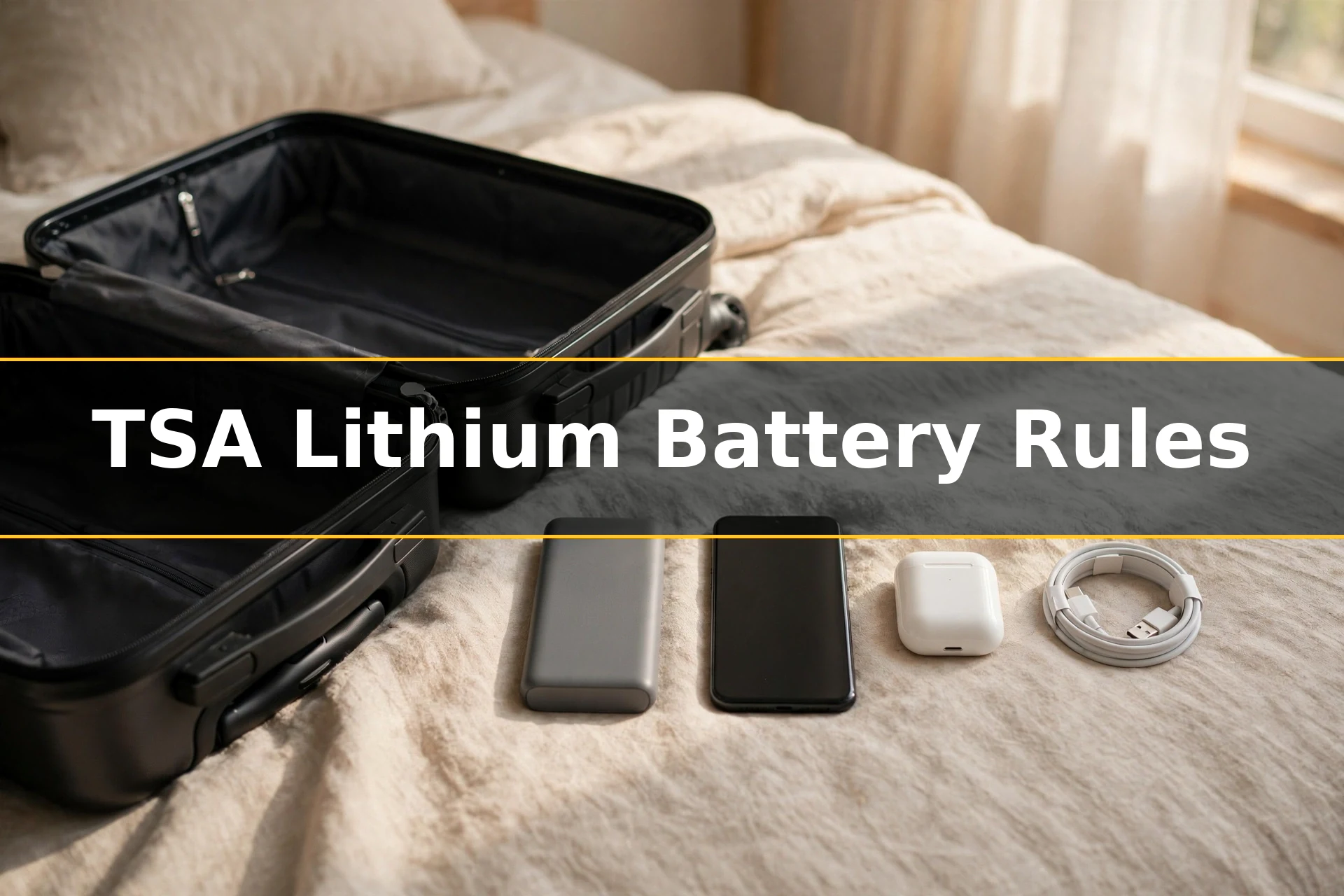
If you remember nothing else from the TSA lithium battery rules, remember these two points. First, spare lithium batteries — including every power bank and portable charger you own — must travel in the cabin with you, in your carry-on bag or personal item. They are never allowed in checked baggage, no exceptions. Second, size matters: batteries are measured in watt hours (Wh), and the bigger the battery, the more restrictions apply.
The reasoning is simple safety. If a lithium battery overheats or catches fire in the cabin, the crew can reach it quickly and deal with it. In the cargo hold, a problem battery could go unnoticed for far too long. That is why the rules push every loose battery into the cabin, where people can see and reach it, and why there is a size limit on what you can bring aboard at all.
Power Banks and Spare Batteries
Under the power bank flight rules, a power bank counts as a spare battery, even though it feels like a gadget in its own right. The same goes for spare laptop batteries, spare camera batteries, phone battery charging cases and any other loose lithium battery that is not installed inside a device. All of them belong in your carry-on, and all of them need their terminals protected against short circuits, which we cover in the packing section below.

For ordinary power banks there is good news: the FAA sets no federal limit on how many batteries under 100Wh you can carry for personal use, so two or three travel power banks in your hand luggage are fine. Some airlines do set their own quantity limits, however, so if you carry several large power banks, a quick check of your airline’s policy is worth it. When you shop, look for a travel power bank with its watt-hour rating printed clearly on the case, because that number is what decides whether it can fly.
The 100Wh Limit Explained
The 100Wh battery limit is the number the whole system turns on. A lithium-ion battery rated at 100 watt hours or less can travel in your carry-on with no approval from anyone. Between 101Wh and 160Wh, you need your airline’s approval first, and you may carry a maximum of two spare batteries of that size per person, still in the cabin only. Anything over 160Wh is forbidden on passenger aircraft altogether — batteries that large belong to freight rules, not holiday luggage.
Finding your battery’s rating is easier than it sounds. Most power banks print the watt hours on the case next to the capacity. If only milliamp hours (mAh) are shown, multiply the mAh by the voltage (usually 3.7V for a power bank) and divide by 1,000. That makes a 10,000mAh power bank about 37Wh, a 20,000mAh model about 74Wh, and even a big 26,800mAh power bank roughly 99Wh — just under the limit. This is why almost every consumer power bank is cabin-legal by design, and why we only recommend models under the limit in our guide to the best portable chargers for travel. Spare non-rechargeable lithium metal batteries follow a different scale: each one is limited to 2 grams of lithium content.
Batteries Inside Devices
Batteries that are installed inside a device — your phone, laptop, tablet, camera, headphones or e-reader — are treated more leniently. They are always allowed in your carry-on, and they may also travel in checked baggage, as long as the device is completely switched off (not just in sleep mode) and protected from accidental activation and damage. The same watt-hour limits still apply to the battery inside.
Even so, the cabin is the better place for your devices. Checked bags get dropped, crushed and left on hot tarmacs, and a damaged battery is exactly what these rules are designed to keep out of the hold. Our advice is simple: if a device is valuable, fragile or powered by a lithium battery you care about, carry it on. Save the checked bag for chargers with no batteries inside them, cables and clothes.
Smart Luggage and Vapes
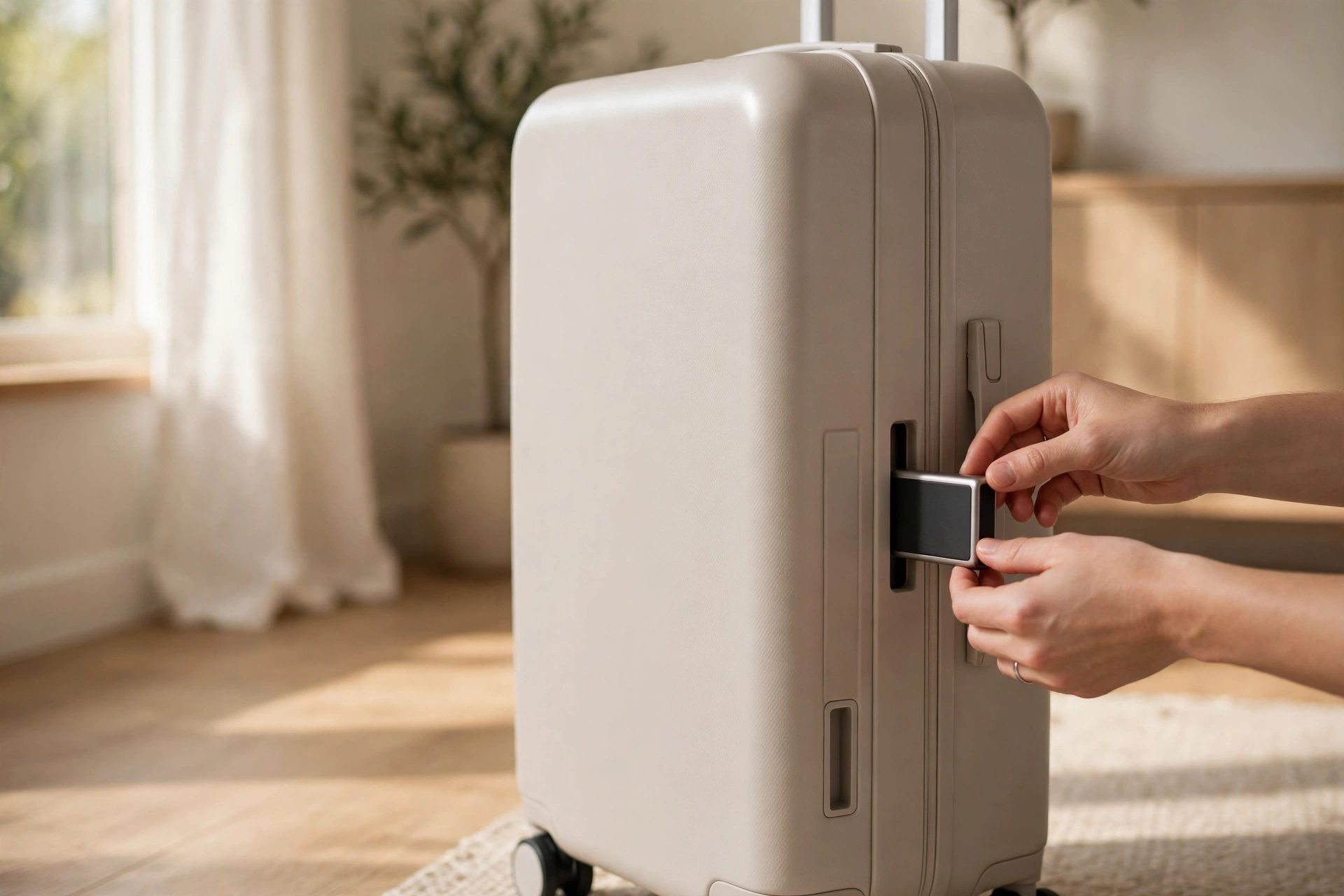
Smart suitcases with built-in batteries, GPS trackers, scales or charging ports have their own trap. To check a smart bag, its lithium battery must be removable — you take the battery out, carry it in the cabin like any other spare, and only then can the bag go in the hold. If the battery cannot be removed, the bag cannot be checked at all, and because many airlines refuse non-removable smart bags entirely, that expensive case can become effectively unusable for flying. Even as a carry-on, some airlines ask for the battery to be removed or switched off, so check before you travel.
E-cigarettes and vaping devices follow a stricter version of the same logic: cabin only, never in checked baggage, and you must not use or charge them on board. Keep them somewhere they cannot switch on by accident, such as a case or with the battery removed where the design allows it.
Damaged or Swollen Batteries
One category of battery should never fly at all: anything damaged, defective or recalled. A power bank with a swollen or bulging case, a phone battery that has been punctured or crushed, a device that gets unusually hot while charging, or a battery covered by a manufacturer recall must stay at home. The TSA lithium battery rules and FAA guidance are clear that these are a safety risk, and security staff can refuse them if they spot them.
Check your kit before every trip. If a power bank’s casing is splitting, a battery no longer sits flat, or a device smells sweet or chemical, retire it and recycle it through a proper battery recycling point. And if a device ever gets hot, starts smoking or swells during a flight, do not try to charge it or move it yourself — alert the cabin crew immediately. They are trained and equipped for exactly that situation.
How to Pack Batteries Safely
Packing well is the part of the power bank flight rules that is entirely in your hands. Spare batteries must be protected from short circuits and damage, and there are several easy ways to do that:
- Keep each spare battery in its original retail packaging, a battery case or its own small pouch or zip bag, so the terminals cannot touch anything metal.
- If a battery has exposed terminals, cover them with tape.
- Never let loose batteries rattle around with coins, keys or other metal objects.
- Keep all spares together in one easy-to-reach place in your carry-on, so you can show them at security without unpacking your whole bag.
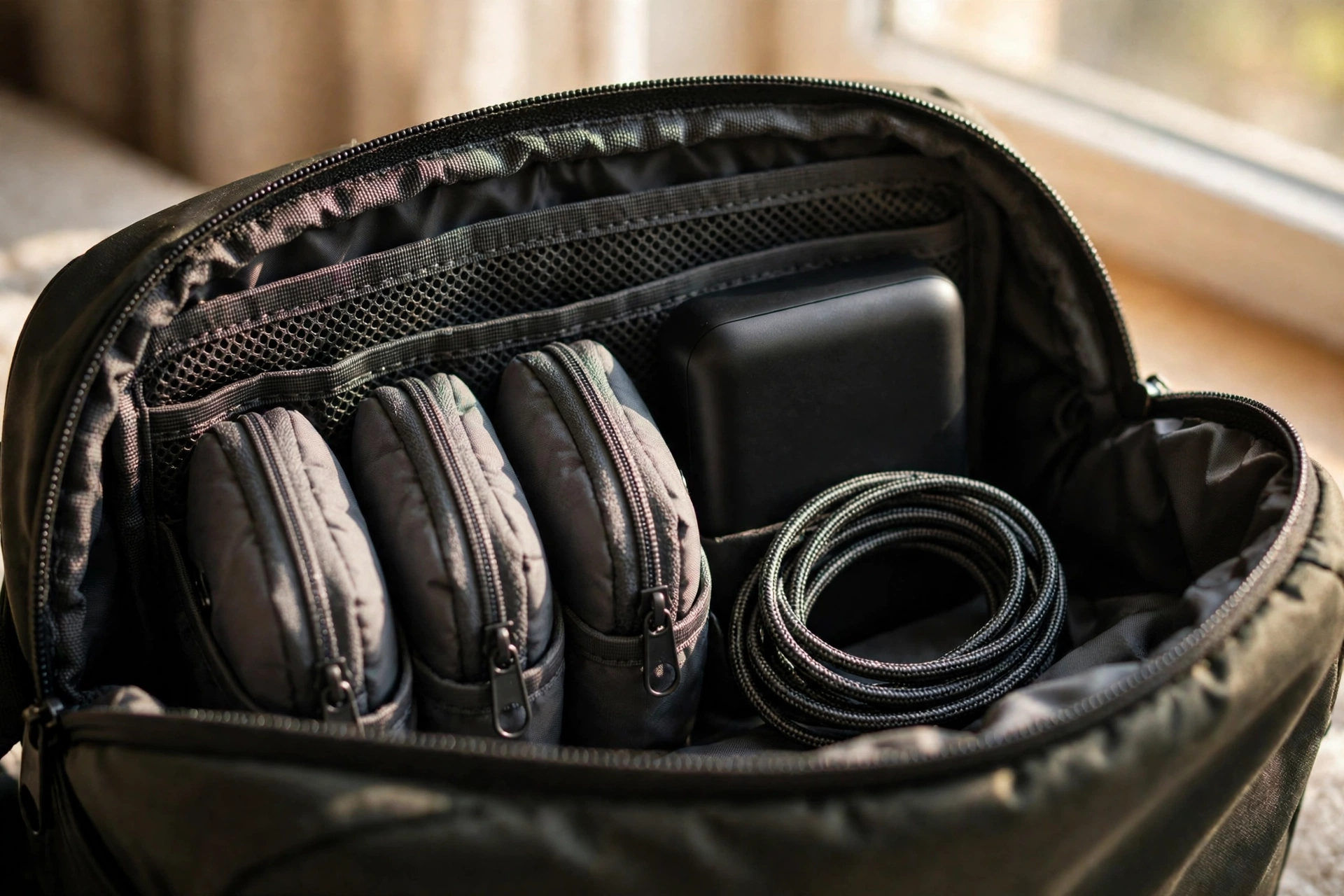
A small pouch for each battery takes seconds to pack and prevents the one accident these rules worry about most. If you are upgrading your kit, a compact power bank sized for carry-on travel will already be under the 100Wh battery limit and small enough to keep in your personal item, which is the easiest way to stay legal.
What Happens at Security
In practice, screening is uneventful when you have packed properly. Your carry-on goes through the scanner like everyone else’s, and an officer may ask you to open the bag so they can look at a battery, check its watt-hour rating or swab it. Keep power banks where you can reach them and it takes a minute at most. Remember that the final decision on any item rests with the officer at the checkpoint, and airline staff at the gate can ask about batteries too — a power bank found in a checked bag at any point will be removed, and you will not get it back.
Final Thoughts
The TSA lithium battery rules come down to a short checklist: spares and power banks in the cabin, never in checked bags; stay at or under 100Wh per battery unless you have airline approval for up to 160Wh; devices switched fully off if they must be checked; vapes in the cabin and unused; smart bag batteries removed and carried with you; and damaged or swollen batteries left at home. Pack your spares protected and reachable, and lithium batteries on planes stop being a worry and go back to being what they should be — the quiet reason all your travel gadgets just work.
More Guides You’ll Like
- Best Portable Chargers for Travel: Compact Power Banks for Carry-On Trips
- Best 10 Travel Gadgets for 2026: Essential Tech for Every Trip
- Best Bluetooth Luggage Trackers: 12 Tags and Cards That Help You Find Your Bags
- Travel EDC Gadgets Guide: 12 Everyday Carry Tech Essentials for Every Trip
Frequently Asked Questions
Can you take a power bank on a plane?
Yes. Can you take a power bank on a plane in checked luggage is the real question, and the answer to that is no — power banks must always travel in your carry-on bag or personal item. As long as yours is rated at 100Wh or less, which covers nearly every model sold for travellers, you can carry it with no approval needed.
How many power banks can I take on a plane?
For batteries under 100Wh, the FAA sets no fixed number for personal use, so a couple of power banks plus spare camera batteries is perfectly normal. For larger 101–160Wh batteries, the limit is two spares per person, and only with airline approval. Some airlines set their own quantity limits for all sizes, so check your carrier if you carry a lot of kit.
What happens if I pack a power bank in my checked suitcase?
If it is found — and checked bags are screened, so it often is — the power bank will be removed and disposed of, and your bag may be delayed or opened. Airlines will not return it, and repeat problems can slow you down at check-in. It is the single most common mistake people make with lithium batteries on planes, and the easiest one to avoid.
Are laptops and phones allowed in checked baggage?
They are allowed if the device is completely powered off and protected from damage and accidental activation, but we strongly recommend keeping them in your carry-on instead. The cabin is safer for the battery, safer for the device, and it keeps your most valuable gadgets with you if a checked bag goes missing.