How to Organize a Laundry Routine for a Large Family
In a large family, laundry is never finished — it is only ever at a stage. There is always a load in the machine, a load waiting, a load drying and a load that came back downstairs inside somebody’s sports bag. Trying to “do the laundry” as one heroic weekly event collapses by Wednesday, and the house fills up with the evidence: baskets in hallways, clean piles on beds, and a permanent low-level hunt for a matching pair of school socks.
The fix is not a bigger machine or a sterner attitude. It is a routine — a simple, repeating system where every load has a day, every category has a home, and every stage hands over to the next without anybody having to think hard about it. A routine survives busy weeks, tired evenings and the school-flu month precisely because it does not depend on motivation. It just repeats.
What follows is a framework, not a rulebook. Take the schedule and the sorting system as a starting shape, then bend the days around your family’s actual life — work shifts, sports training, the day the bedding mountain peaks. Start with one or two sections, let them bed in for a week, then add the rest. Within a month, most large families find the laundry has quietly stopped being a household emergency and become background noise, which is exactly where it belongs.
Start with a Simple Weekly Schedule
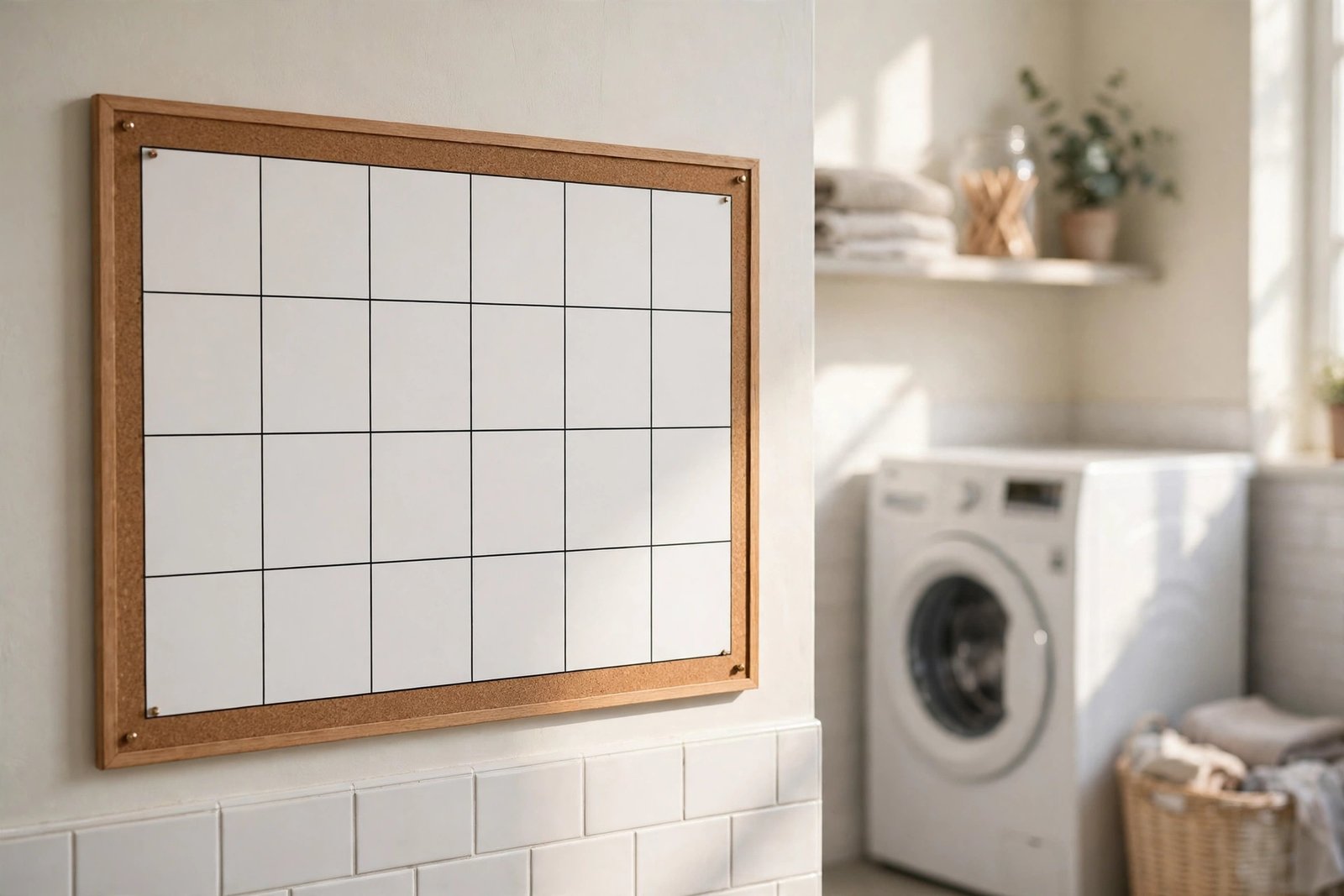
The single most powerful change is giving categories of laundry their own days, instead of washing whatever happens to be overflowing. A schedule spreads the work into small, predictable loads — most days need only one — and it ends the weekend marathon where six loads fight for one machine while everyone needs clean clothes by Monday. It also means deliberate or bulky things stop waiting weeks for a gap that never comes.
A shape that works for many big households:
- Monday: school uniforms and work clothes — the week’s essentials, washed first.
- Tuesday: everyday clothes, darks.
- Wednesday: everyday clothes, lights and colours.
- Thursday: towels — bath, hand and kitchen, on a hot wash.
- Friday: sports kits, swim things and anything that cannot wait out the weekend.
- Saturday: bedding, one or two bedrooms at a time on rotation.
- Sunday: catch-up — the odd load, delicates, and whatever the week invented.
Your version will differ — a family with two in nappies washes daily no matter what the chart says, and a household of teenagers generates a different rhythm entirely. The chart matters less than the principle behind it: nobody decides what to wash each day, because the day decides. Post the schedule where the laundry happens, and let it absorb the arguments. After a few weeks, “it’s towel day” becomes as unremarkable as bin day.
Sorting Systems That Actually Stick
Every failed laundry system fails at the same place: sorting. If clothes arrive in one mixed mountain, somebody has to excavate it before every wash, and that excavation is the job everyone avoids. Sorting systems that stick share one feature — the sorting happens at the moment clothes come off, by the person taking them off, with no thinking required.
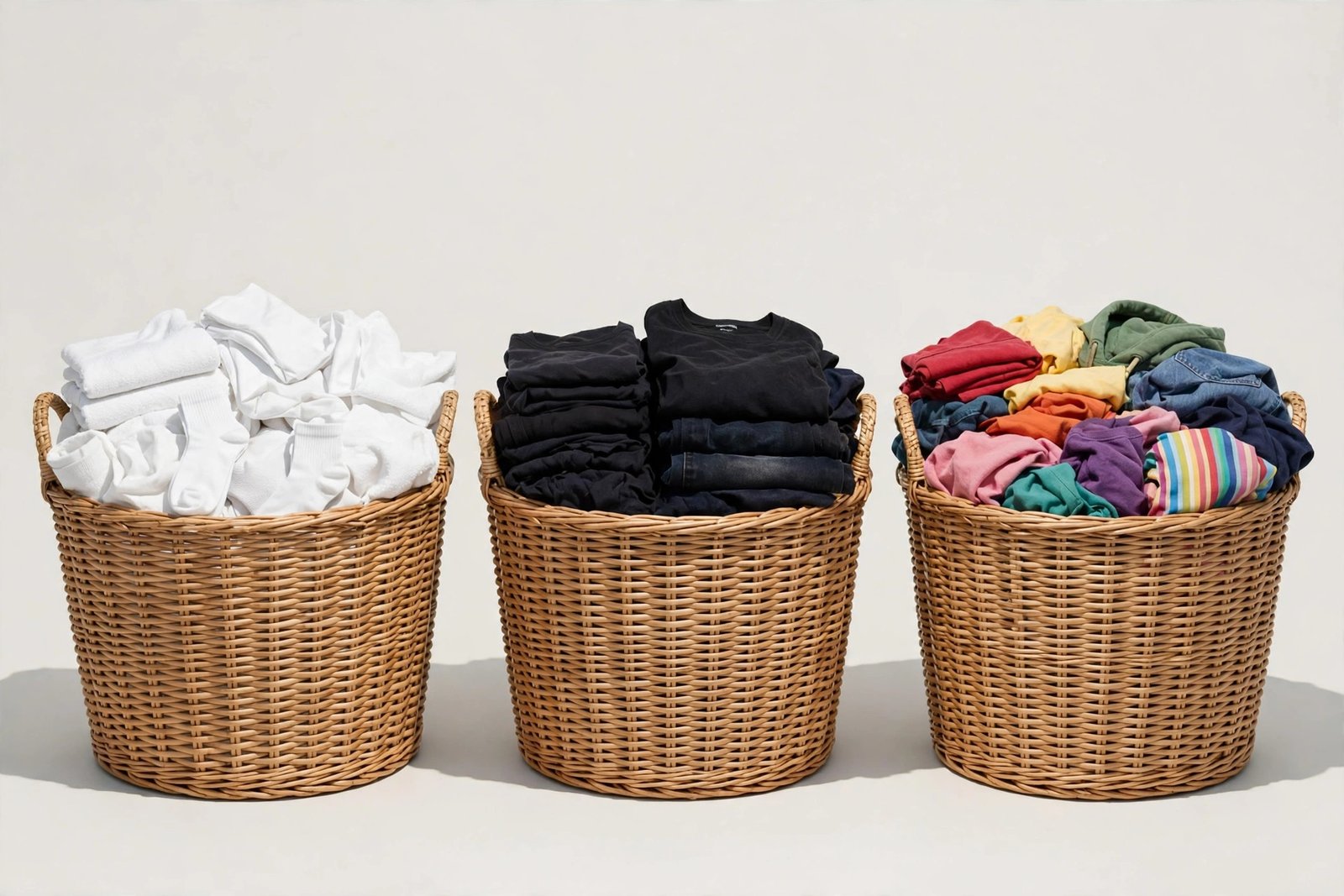
The simplest version is a multi-bag sorter or a row of baskets where the family actually undresses — landing, bathroom or laundry room — labelled by load rather than by person: lights, darks, colours, plus a small one for delicates. When a bag is full, that is a load, and it goes straight into the machine with zero decisions. A separate small basket for heavily soiled things — sports kits, painting clothes, anything muddy — keeps the worst offenders from stewing inside the general population.
Two supporting habits make it hold. First, pockets and zips: emptying pockets and zipping up happens at the basket, not at the machine, which saves both the tissue-in-a-dark-load disaster and a deal of drum noise. Second, children sort their own clothes from surprisingly young — matching a shirt to the “darks” picture label on a basket is a toddler-level skill, and making it their job removes the single biggest sorting bottleneck in the house: you.
A Wash-Day Workflow That Runs Itself
With sorting handled upstream, wash day itself becomes a loop rather than a project. The loop that works in most large households is simple: a load goes on at a fixed anchor point in the day — with breakfast, or the moment everyone leaves for school — and it moves to drying the moment it finishes, not when somebody eventually remembers it. A finished load left sitting in the drum is the hidden source of half of all laundry misery: it smells, it creases, and it quietly becomes a re-wash.
Anchor each stage to something that already happens. Machine on with the morning kettle. Load moved when lunch is made. Dry things folded during a programme everyone watches anyway. These pairings matter more than willpower because they make the routine self-reminding — the kettle is the reminder, not a note on the fridge you stopped seeing in week two. Many families also run the machine overnight or early morning on a delay timer, so the wash is ready to hang at breakfast; if you do this, make sure the finished load still moves promptly once the day starts.
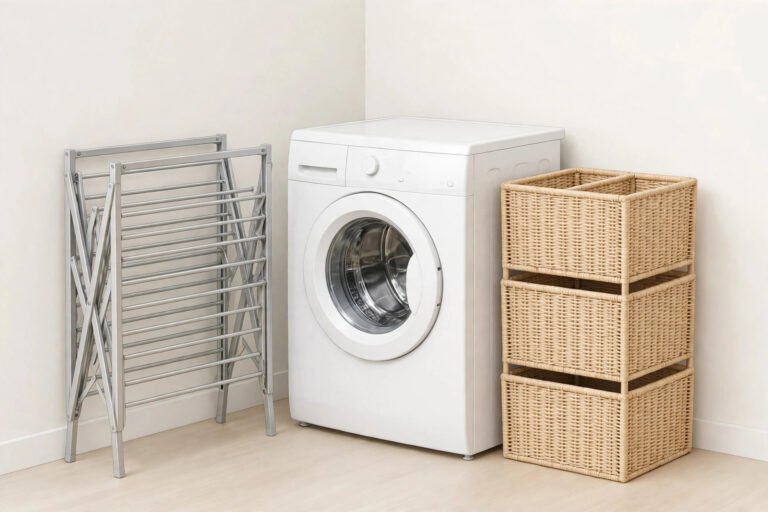
Keep the path short. The route from basket to machine to drying to folding spot should involve as few stairs, doors and obstacles as possible, because every friction point is a place where loads get abandoned. A hamper on wheels, a drying rack that lives where the air moves, a folding surface near where clothes are put away — these small logistics decide whether the loop flows or stalls.
Folding and Putting Away Without the Pile-Up
Ask a room of parents which laundry stage they hate most and folding wins every time — not because it is hard, but because it is where clean laundry goes to live indefinitely. The pile on the bed or the spare-room chair is where routines go to stall: clothes are clean, technically, but nobody can find anything, everything is creased, and half of it gets worn straight off the pile and never sees a drawer.
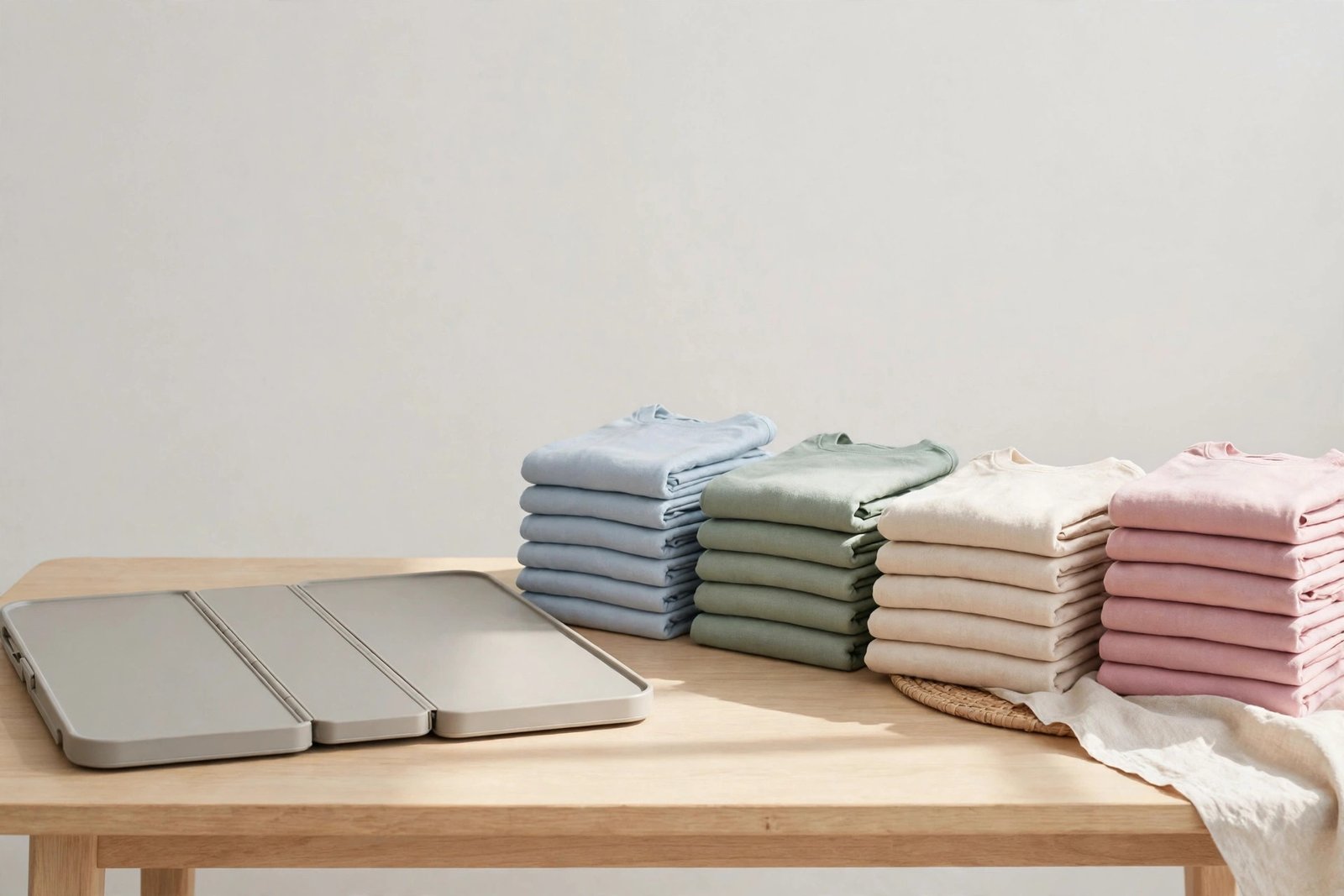
The counter-move is to fold at the point of drying, in small batches, as each load comes in — ten minutes attached to a load, never an hour attached to a mountain. A folding board makes the job faster and, more importantly, uniform: identical folds stack neatly, fit drawers in rows, and can be produced by almost anyone, which brings us to the real secret. Folding is the most delegable job in the house. Children can fold their own clothes with a board or a simple template from primary-school age, and a basket-per-person system — each person’s clean clothes land in their own basket, and the basket’s owner puts it away — removes the final distribution round entirely.
Set a house rule that protects the system: nothing clean sleeps on a bed or a chair. If a load cannot be folded yet, it stays in its basket in the laundry area, off limits, rather than colonising a bedroom. It sounds strict for about a week. Then the pile simply stops existing, and with it goes the daily archaeological dig for a particular shirt.
Keeping the Machines Clean and Ready
A routine is only as reliable as the machines underneath it, and machines that wash daily need a little routine of their own. The washing machine first: leave the door and the detergent drawer ajar between washes so the drum dries out instead of growing that stale smell that transfers to clothes. Wipe the door seal weekly — in a high-use machine it collects hair, grit and moisture — and clear the filter on a regular cycle, because a clogged filter is the usual suspect when drainage slows or cycles start erroring.
Run a hot maintenance wash — empty, hottest programme, with a machine cleaner or a cup of white vinegar in the drum — every month or so in a daily-use household, more often if washes are mostly cool. Detergent deserves a mention too: in hard-working machines, more detergent is not better; excess builds up in the drum and on clothes. Measure for the load size, and treat the dosing guide as a ceiling, not a target.
The dryer needs the same respect. Empty the lint filter after every single load — in a family doing two loads a day, a neglected filter doubles drying time within a week — and check the vent run a few times a year for lint build-up, especially if drying times creep up. A machine that dries slowly is usually a machine that cannot breathe, not a machine that is dying. Ten minutes of maintenance a month keeps the whole routine honest.

Final Thoughts
A large family’s laundry will never be small, and no routine will make it disappear. What a routine does is change its shape: from a recurring crisis with a mountain in the middle, into a set of small, boring, predictable steps that happen almost without discussion. A wash day for each category, sorting done by whoever takes the clothes off, loads anchored to moments that already exist in the day, folding in small batches by many hands — none of it is clever, and all of it compounds.
Start smaller than you think you should. Put the schedule on the wall and set up the sorting baskets this week; add the rest once those two hold. Judge the system after a month, not after a bad Tuesday. The goal was never a laundry room worthy of a photograph — it is a house where clean clothes are simply where they should be, every day, without anybody having to heroically make it so.
More Guides You’ll Like
If you want the hardware that makes this routine easier — sorters, racks, folding boards and the rest — our product guide to the Best Laundry Room Gadgets for Large Families with Daily Washing rounds up the twelve picks that earn their place in a daily-wash household. And for calmer starts at the other end of the day, see How to Speed Up Your Morning Routine, which applies the same night-before, no-queue thinking to the morning rush.
Frequently Asked Questions
How many loads a week does a large family actually do?
Most households of five or six land somewhere between eight and fourteen loads a week once clothes, towels and bedding are counted — roughly one to two a day. That sounds like a lot written down, but it is exactly why a schedule beats a weekly marathon: one load a day is a chore, while ten loads on Sunday is a lost weekend.
What if our family’s week doesn’t follow a pattern?
Then keep the categories and drop the clock. The schedule’s real value is deciding in advance what gets washed together and in what order — you can run “towel day” whenever the towel basket fills rather than strictly on Thursday. Shift work and irregular weeks bend the timetable; the sorting system and the fold-as-you-go habit carry the routine on their own.
How do I get children to actually help with laundry?
Give them a whole stage, not a fragment. Young children can sort into labelled baskets and match socks; older ones can own a basket — their clean clothes arrive in it, and emptying it into their drawers is their job. Folding boards turn folding into something closer to a game. The principle is the same as for adults: a small, defined, repeating job sticks, while “help with the laundry” as a general request never does.
How do we stop clean laundry piling up unfolded?
Fold per load, not per week, and attach the folding to something that already happens — a programme, a podcast, a phone call. Keep each person’s folded clothes in their own basket so distribution is one trip, and hold the line on clean clothes never landing on beds or chairs. If the pile still forms, the load size is probably too big: smaller, more frequent loads fold in minutes and rarely become a mountain.