

How to Light a Patio and Pathway with Solar Lights
A patio or garden path that disappears at dusk is a wasted part of the home, and learning how to light a patio and pathway with solar lights is the simplest way to bring it back after dark. Solar lights need no wiring, no electrician and no running costs: a small panel on each light gathers daylight, a battery stores it, and the light switches itself on when the sun goes down. In an evening you can turn a dark path into a clear, welcoming walk and a plain patio into a place to sit.
The method is straightforward, and it works in any garden. The first step is the sun: find the spots that get direct daylight, because a solar light is only as good as the charge its panel receives. The second is the light itself: choose the right type for each spot — stake lights along a path, string lights over a patio, spotlights for a tree or a wall. The third is the layout: space the lights so the path reads clearly, with no dark gaps and no dazzling glare. And the fourth is the habit: a quick clean of the panels and a battery check now and then, so the lights keep glowing season after season. This guide walks through each step, so your patio and pathway stay lit from the first evening onwards.
Start with the Sun: Where the Light Falls
Every solar light is a small solar power station, and its panel is the whole story. A panel in full sun for most of the day will run its light for hours after dark; a panel in shade will glow weakly and fade early. Before you buy anything, spend a day watching your garden. Note which parts of the patio and the path get direct sun in the morning and the afternoon, and which parts sit in the shadow of the house, a fence or a large tree. The sunny spots are where the lights belong — or, for lights with a separate panel, where the panel belongs.
South-facing spots gather the most sun in northern gardens, and a spot that is sunny from late morning to late afternoon is ideal. If your path runs along a shaded wall, look for solar lights with a panel on a cable, so the light can sit in the shade while the panel sits in the sun a few steps away.
Watch out for seasonal shade as well. A path that is sunny in summer may sit in the shadow of a neighbour’s tree in winter, when the sun is lower, and a patio that bakes in July may be shaded by the house itself in December. If you are planning a permanent layout, check the sun in the season you will use the lights most, and place the lights where the sun actually falls then — not where it falls on the brightest day of the year.
Finally, remember that a solar light does not need blazing sun to charge — it needs daylight, and it charges on cloudy days too, just more slowly. A light that gets a few hours of direct sun and the rest of the day in bright shade will still work, though it will not burn as long.

Choose the Right Light for Each Spot
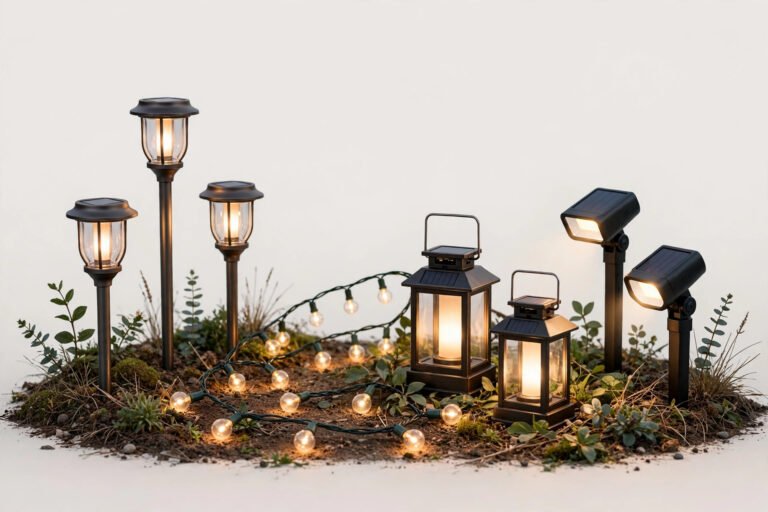
A patio and a pathway need different lights, and the mistake most people make is using one type everywhere. Path lights — short stakes with a small lamp on top — are made for the ground: they mark the edge of the path and light the surface under your feet. String lights are made for the air above a patio: draped across a fence, a pergola or a wall, they give a soft, festive glow over the whole seating area. Spotlights are made for features: a tree, a wall, a statue, a corner of the garden that deserves attention.
For the path itself, stake lights are the workhorse. Push them into the soil at the edge of the path, about a stride apart, alternating sides so the light zigzags gently down the walk. A warm white glow is kinder than a cold blue one, and a light with a frosted cover spreads its glow more evenly than a bare bulb. Keep them low — a stake light should light the path, not your eyes — and choose lights with a sturdy stake, so they stay upright in wind and rain.
For the patio, string lights do the most with the least effort. Hang them in a gentle swag between two fixed points — a fence post and a wall, two posts, or hooks under a pergola — with enough slack that they curve naturally. A string of warm white bulbs turns a plain patio into an evening room, and a dimmer or a choice of brightness settings lets you set the mood: brighter for a meal, softer for a quiet drink. Keep the strings high enough to walk under without ducking, and keep the plugs and joints out of standing water.
For features, a solar spotlight or a wall light adds depth. Aim a spotlight up a tree trunk, at a textured wall or across a flower bed, and the garden gains a second layer of light beyond the path and the patio. A wall light by the back door lights the step and the lock, which is the most practical light in the whole garden — the one you use every evening when you come home.

Set Them Out So the Path Reads Clearly
A good layout is one you can walk without thinking. The path should read as a line of light from the gate to the door, with no dark gap wide enough to hide a step, a root or a puddle. Space stake lights about a stride and a half apart — close enough that their pools of light overlap slightly, far enough that they do not crowd each other. If the path turns, put a light on the outside of the turn, where the eye naturally looks, so the turn itself is lit.
Light the changes in level first. A step, a ramp, a change from paving to gravel — these are the places where people trip, and they deserve a light each. Flat, straight stretches need fewer lights; changes of level need more.
Keep the patio seating area separate from the path in your mind. The path lights are for walking; the patio lights are for sitting. A string of lights over the table, a couple of lantern-style solar lights on the table itself, and a spotlight on the wall behind the seats give a sitting area its own glow, so nobody has to sit in the glare of a path light. The two zones should meet gently — a stake light where the path reaches the patio edge links them without blurring them.
Finally, walk the layout at night after fitting it, and move any light that leaves a dark patch or shines into someone’s eyes. The test is simple: can you walk from the gate to the back door, find the step, and sit down at the patio table without hesitating? If the answer is yes, the layout works. If a light dazzles you as you walk towards it, tilt it down or move it a step to the side — a light that blinds is worse than no light at all.

Keep Them Charging and Working
Solar lights are low maintenance, but they are not no maintenance, and the one job that matters most is keeping the panels clean. Dust, leaves, bird droppings and pollen all block the light that the panel needs, and a dirty panel can halve a light’s run time. Wipe each panel with a damp cloth once a month in summer and once a fortnight in autumn, when leaves fall — it takes a minute per light, and it is the difference between a light that glows all evening and one that fades by nine.
Check the batteries once a year, usually in spring. Most solar lights use a small rechargeable battery that lasts a year or two, and when it weakens the light will glow dimly or not at all even after a sunny day. A fresh battery of the same type usually restores the light completely, and it costs very little — so do not throw a light away because it has gone dim; try a new battery first. Keep spare batteries in a drawer, and mark the calendar for a spring check.
In winter, expect shorter nights of light. Short days and low sun mean less charge, so the lights will not burn as long as they do in summer — that is normal, not a fault. You can help them by moving the panels to the sunniest spot available in winter and by cleaning them more often.
And store the lights you do not use through the winter properly: clean the panels, switch the lights off, and keep them somewhere dry, so they are ready to go out again in spring. A solar light that is looked after will last for years, and the garden it lights will be used far more than a garden that goes dark at dusk — because a lit patio is a patio people sit on, and a lit path is a path people walk with confidence.

Final Thoughts
Lighting a patio and pathway with solar lights is one of the easiest improvements you can make to a home: no wiring, no running costs, and an evening’s work to fit. Start with the sun, choose the right light for each spot, space the path lights so the walk reads clearly, and keep the panels clean — that is the whole method, and it works in a small courtyard as well as a large garden.
Begin with the path from the gate to the back door if you have not started yet — a row of stake lights there covers the walk you make every evening — then add the string lights over the patio and a spotlight for a favourite tree. Walk the garden at night after fitting, move any light that leaves a dark patch, and enjoy the extra hours the lights give you outside.
More Guides You’ll Like
For the lights that make all of this easier — solar stake lights, string lights, spotlights and lanterns — see our product guide to the Best Solar Lighting Gadgets for Patios and Pathways, which rounds up twelve picks chosen for patios and pathways. And for lighting the hallway and stairs inside the house, Best Motion Sensor Light Gadgets for Hallways and Stairs covers the route from the bedroom to the bathroom.
Frequently Asked Questions
How long do solar lights stay on at night?
Most solar lights glow for six to eight hours after a full day of sun, though the exact time depends on the size of the panel, the battery and how much direct sun the panel received. A light in full sun will burn longer than one in shade, so check the panel position first if a light fades early.
Do solar lights work on cloudy days?
Yes, but not as well: the panel still gathers light on a cloudy day, so the light will charge, just more slowly, and it will not burn as long that night. If your garden is often cloudy, choose lights with larger panels, which charge better in weak light.
Where should I put solar path lights?
Along the edge of the path, about a stride and a half apart, alternating sides so the pools of light overlap slightly and there is no dark gap between them. Put a light on the outside of any turn, and one beside each step or change of level, so the places where people trip are the best lit places on the path.
How do I keep solar lights working for years?
Keep the panels clean with a damp cloth once a month, replace the rechargeable battery when the light grows dim even after a sunny day, and store lights you do not use through winter somewhere dry with the switch off. A clean panel, a fresh battery and a little care will keep most solar lights glowing for years.




One Comment